

Vertical SaaS keeps grabbing headlines, and for good reason. The SaaS market blew past $450 billion in 2025, but honestly, the size isn’t what matters most - it’s where that money’s going. Vertical SaaS, specialized software tailor-made for one industry, now takes up about $157 billion of that total. And the wild part? Its growth rate sits at 18–22% year-over-year, while the horizontal giants you’ve always heard about are lagging behind at 12–15%.
That gap isn’t shrinking. It’s only getting wider.
Just look around. Veeva Systems pulls in $2.45 billion by focusing entirely on life sciences. Procore raked in $780 million - all in construction. Toast? They’re running over $5 billion in payment revenue, exclusively from restaurants. These aren’t tiny, hidden gems. They define their categories by choosing depth over breadth.
So, if you’re a founder and you’re torn between making a tool that serves everyone versus going all-in on one industry, the numbers lean heavily toward picking a niche and owning it. Let’s dig into why - and what it means for how you build, sell, and grow your product.
Why Vertical SaaS Wins
For years, everyone thought horizontal SaaS was the smart play, since the potential customer base was enormous. The thinking went: build a CRM, a project tool, some analytics platform, and sell to anyone, anywhere.
But times have changed. Three big shifts have completely changed the game.
1. Switching Hurts More, So Customers Stick Around
When a restaurant puts its payments, menu, inventory, and payroll on Toast, ditching it isn’t just annoying - it’s a full-on disruption to the business. You can swap project management tools pretty easily, but when your whole operation depends on a single platform, switching means you're ripping out the core. This creates what investors call “negative churn” - because your users actually do more business with you over time instead of leaving.
Tidemark’s 2025 Vertical SaaS Benchmark nails this: vertical companies get 40–50% higher sales efficiency than horizontal rivals. Their Net Revenue Retention is consistently better, because the software’s integrations run deeper and it’s way tougher to leave.
Numbers don’t lie. Median B2B Net Revenue Retention is about 106%, but vertical platforms regularly hit 120% or more. Stripe’s latest data goes even further - platforms with embedded financial services lose fewer customers and grow revenue almost 50% faster than basic software-only competitors.
2. Selling Gets Cheaper (By A Lot)
Trying to sell to “all businesses” sounds nice until you realize you’re butting heads with giants like Salesforce and Google every time. Vertical SaaS companies pick their battles - they target specific buyers, they show up at niche conferences, and they speak their customers’ language. They use real-world examples and reference pain points generic SaaS can’t touch.
The effect? Their customer acquisition costs are up to 8x lower than horizontal competitors. When your marketing says “built for dental clinics” instead of “built for small business,” you’re talking directly to the right people, and they really notice.
3. Compliance Isn’t Optional - It’s a Selling Point
Some industries can’t even consider generic tools. Healthcare, finance, construction - if you don’t check the boxes for HIPAA, PCI-DSS, SOC 2, FDA SaMD, you’re out. Vertical SaaS makes compliance core to their product.
When building for healthcare apps, HIPAA isn’t just a feature - it should be baked into the code: encryption, audit logs, role-based access, BAA management, all that stuff happens from day one. It's not an afterthought.
This creates a moat competitors can’t easily cross. A generic CRM trying to bolt on “healthcare mode” is always going to lag behind one built from scratch for the job. And every year, regulations change, piling up more expertise and making it even harder for outsiders to catch up.
Vertical SaaS isn’t just picking a niche - it’s building an unbeatable foundation. The barrier to entry gets higher, and the rewards keep getting bigger. Why go broad and fight for scraps when you can go deep and own the whole category?
The Revenue Multiplier: How Vertical SaaS Expands TAM Through Embedded Services
The most important shift in vertical SaaS lately isn’t really about writing software-it’s about stacking financial services right into those platforms. Leaders in the space aren’t treating this as some extra perk anymore. It’s the main way they drive growth.
Just look at the numbers:
| Company | Industry | Software Revenue | Fintech Revenue | Fintech % |
|---|---|---|---|---|
| Toast | Restaurants | $706M (subscriptions) | $4.1B (payments) | ~85% |
| Shopify | E-Commerce | 27% (subscriptions) | 73% (merchant solutions) | 73% |
| ServiceTitan | Home Services | 71% (subscriptions) | 25% (fintech) | 25% and growing |
For Toast (think restaurants), $706 million comes from software subscriptions, but payment processing brings in a staggering $4.1 billion-about 85% of the company’s revenue now. Shopify’s story is similar: subscriptions make up 27% of its business, while merchant solutions like embedded payments and lending pull in the other 73%. ServiceTitan, focused on home services, started out with most of its money from subscriptions, but fintech is catching up fast-now at 25% of revenue, and still growing.
Toast’s path tells you everything, really. They started as the software tool for restaurant owners-point of sale, basic reporting, that sort of thing. But today? The big money’s in payment processing, lending, and financial services. The software lays the rails, but now those rails carry way more valuable trains.
Shopify ended up in the same place. Stuff like embedded payments, lending through Shopify Capital (over $4 billion just last year), and their banking tools now make up almost three-quarters of their revenue.
And ServiceTitan? Their fintech slice is catching up with subscriptions. After adding “Buy Now, Pay Later” with Affirm, they’ve sunk even deeper into the money flows themselves.
The Embedded Finance Playbook
So how do the best SaaS companies pull this off? They follow almost the exact same playbook:
- They tackle payments first build payment processing into the existing workflow, where the transactions actually happen.
- Next, they add lending using all the data from payments to underwrite loans or advances.
- Then they expand into insurance, banking, payroll, corporate cards. Each layer builds on the data from the step before.
The sequence isn’t just for show. Each service creates a deeper understanding of the customer’s business, and that data de-risks whatever comes next. If you see every payment a restaurant handles, you can safely offer them lending. Once you’ve lent to them, you suddenly know enough to sell insurance, too.
Throwing these features into the mix doesn’t just bump deals a little-they often double, triple, or even quintuple revenue per customer. And because these platforms already live right at the transaction point, they’re best positioned to capture the massive, growing embedded finance market-expected to hit $51 billion in the U.S. alone by 2026.
That’s the real TAM expansion: “restaurant software” gives you a limited market. Become “the financial operating system for restaurants,” and the ceiling just disappears.
Want to turn your vertical software into a financial operating system?
We’ve helped vertical SaaS teams layer embedded payments, lending, and payouts onto their core workflow - the move that takes revenue per customer from subscription-only to 2-5x higher, without bolting on a payments product that doesn’t fit the way your industry actually works.
Book a free scoping call and we’ll map which embedded finance services fit your vertical, the data you’ll need to underwrite them, and a realistic rollout sequence with budget and timeline.
The AI Moat: Why Industry-Specific Data Is the Real Defensibility
But there’s another shift happening: AI is changing everything for vertical SaaS-creating a threat and a moat at the same time.
On the threat side, AI blurs the lines. Rival tools can copy any generic workflow feature with lightning speed. If your big selling point is “it organizes inventory with a nice UI,” AI-powered competitors can catch up in no time.
But here’s the moat: vertical SaaS companies don’t just handle generic data-they live inside the daily pulse of their industries. That means they get access to massive amounts of industry-specific, real-time information: sales trends, staffing schedules, menu tweaks, and so on. With that kind of data, they can train AI models to forecast demand, recommend prices, or optimize operations in ways that big, broad, “horizontal” tools just can’t touch.
The best part? This becomes a flywheel:
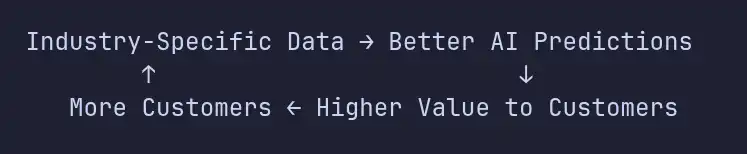
Better industry data makes your AI smarter. Better predictions win you more customers. More customers mean more data. The flywheel turns faster, giving you an advantage rivals can’t easily steal. That’s why investors are throwing money at vertical SaaS companies building AI-native platforms for legal, healthcare, and finance.
AI-Native vs. AI-Enabled: The Architecture Distinction
There’s a big difference between AI-enabled and AI-native, by the way.
AI-enabled means you tack some smart features onto an existing workflow tool-maybe smarter search, automated reporting, predictive alerts. Helpful, but the engine is still fundamentally the same as before.
AI-native means you start from scratch, building the whole platform around AI. Every part of the product-how it stores data, how it processes info in real time, how users interact-is designed to use AI as its core. Not just to give you recommendations or pretty graphs, but to actually get stuff done for you, automatically - the kind of agentic workflows that act, not just advise.
The technical difference matters. An AI-native architecture typically requires:
- Event-driven data pipelines that capture operational data in real-time, not batch
- Feature stores that serve both the application and ML models from the same source of truth
- Feedback loops where model predictions are validated by actual outcomes and automatically retrained
- Multi-tenant model isolation so one customer's data doesn't leak into another's predictions
In practice? We’ve found that hybrid models work best for these AI-heavy workloads: standard customers share infrastructure, with data partitioned for security, while big enterprise clients can get their own databases or isolated schemas. It keeps costs sane without sacrificing the privacy that healthcare, finance, and regulated industries absolutely demand.
Vertical SaaS isn’t just about building better workflows anymore. It’s about controlling the core data stack, embedding finance, and building an AI-powered moat that keeps getting deeper.
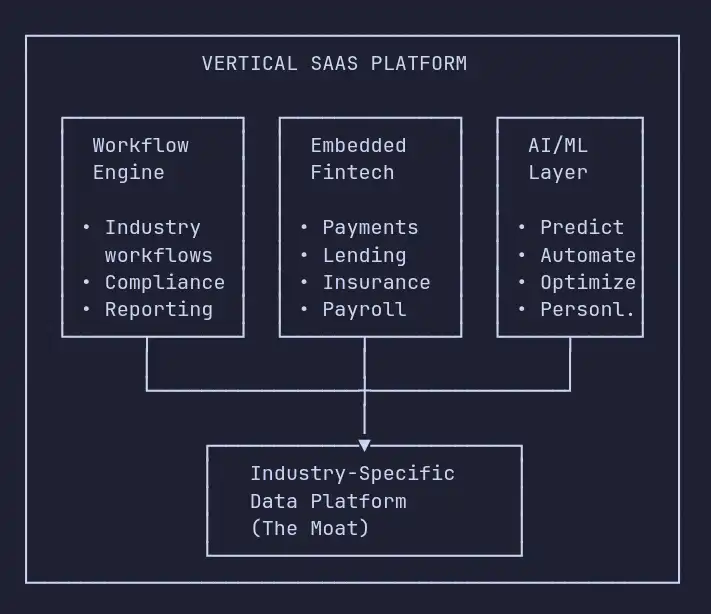
Everything starts with the three core layers - workflow engine, embedded fintech, and the AI/ML stack - all plugged into a single data platform built for a specific industry. That’s the real defensibility here. The software pulls in the data. The data feeds the AI. The AI pushes the software to get smarter. Fintech takes a cut of every transaction. Each layer powers up the others.
Not sure how to architect multi-tenant isolation for a regulated vertical?
We’ve made these calls across healthcare, fintech, and other compliance-heavy industries - shared schema vs. dedicated databases, event-driven pipelines, feature stores, and where AI-native actually earns its keep versus where it’s premature.
Book a free scoping call and we’ll map your requirements to the right architecture, with a realistic budget and timeline - without overbuilding or underspending.
Five Industries Where Vertical SaaS Has Broken Through
Vertical SaaS isn’t just a theory. In the past few years, certain industries have watched winners take the crown. Some markets are already mature, but there’s still plenty of open territory.
Healthcare IT - $52 Billion Market
Veeva Systems nailed it: $2.45B in revenue, $35B in market cap, all focused on one industry. And healthcare isn’t just one thing - there are tons of sub-verticals still getting digitized, like clinical trials, remote patient monitoring, mental health, and pharmacy management.
If you’re hunting for a moat, healthcare has a giant one. Deep compliance. HIPAA, FDA rules for software, and tricky medical data standards are huge projects. It takes time and serious engineering muscle to build for this world.
Construction Tech - $18 Billion Market
Procore stands out, owning construction project management with $780M in revenue and a $12B valuation. But there’s much more beyond project management - estimating, bidding, keeping track of safety regulations, equipment, and workers. All of these scream for tailored software.
Construction is also ripe for AI. Think smarter scheduling, predicting materials needs, and flagging safety risks early. You need industry-specific data to train good models - and this field is loaded with it.
Restaurant and Hospitality
Toast’s leap from a software company to a $5B+ payments juggernaut is a textbook play. Restaurants have been quick to jump on AI features, like forecasting demand, tweaking prices on the fly, managing inventory automatically, and using AI for better customer connections.
Legal Tech - $12 Billion Market
Clio turned into the heart of law firm operations. Legal tech now goes further - AI-driven contract analysis, predicting case outcomes, automated compliance checks. Law has high-value deals, complicated compliance, and endless paperwork. It’s practically begging for specialized SaaS.
Financial Services
Fintech gets all the headlines, but behind the scenes, vertical SaaS is upending how financial institutions run - automating compliance, streamlining KYC/AML checks, handling risk, knocking out regulatory reports. These systems have huge switching costs (no one wants to swap compliance platforms) and constant rule changes, which means customers have to keep investing in updates.
If You’re Building SaaS, What’s the Move?
As a founder or CTO eyeing your next product, here’s the cheat sheet:
When You Should Go Vertical
- Your target industry has tough, specific compliance hurdles that keep copycats out
- There’s serious money moving through your customers' workflows - you can tap into transactions
- Industry workflows aren’t generic; off-the-shelf tools need a ton of tweaking just to fit
- You and your team know the space inside out
- The market’s big enough to matter but fractured enough that no one owns it yet
When Horizontal Still Wins
- You’re working on a problem pretty much every industry deals with, like messaging or source control
- You’re building infrastructure, not an end-user app - think databases, auth, payments
- The market’s so massive that even a fraction is enough to build a solid business
- Your main edge comes from tech chops, not deep understanding of one vertical
Early Architecture Choices Matter
Going vertical changes your technical map:
- Data modeling - Structure the backend around industry-specific concepts. In healthcare? Patients, encounters, diagnoses, not just “contacts” and “events.”
- Compliance-first infrastructure - Bake in audit trails, encryption, granular permissions, and data locality. Patching on compliance later costs way more.
- Multi-tenant isolation - Decide early: shared schema (cheaper, faster for most), dedicated (best for enterprises). A blend might be the sweet spot.
- API-first - Expect to plug into industry software like EHRs, ERPs, or payment rails. Make sure your APIs can flex as you grow.
- Event-driven - If you’ll ever want AI or embedded fintech (and you should), build around operational events from the start. That’s the data fuel for next-gen features.
Still weighing whether to go vertical or stay horizontal?
We’ve helped founders and CTOs pressure-test this exact decision - compliance moats, transaction volume, workflow depth, and how fragmented the market really is - before they commit real engineering budget to one path.
Book a free scoping call and we’ll map your product to the right approach and architecture, with a realistic budget and timeline so you don’t overbuild or underspend.
Investment Is Roaring In
Investors aren’t waiting. Last year, VCs poured over $18 billion into vertical SaaS, up 40%. They’re especially hungry for startups fusing AI with industry-specific workflows, trained on their own real-world data.
The vertical SaaS market should hit $499 billion by 2035, climbing at 16% a year. But the true prize is how embedded services blow up the total addressable market. Start with subscriptions, end up handling the financial plumbing for a whole sector - suddenly your market is much, much bigger.
What You Should Remember
- Vertical SaaS is outpacing horizontal: growing at 18–22% a year, versus 12–15%.
- Industry-focused platforms pull off 40–50% better sales efficiency and up to 8x lower customer acquisition costs.
- Embedded fintech is the real moneymaker: bumps up revenue per customer by 2–5x.
- Building AI into the core creates a moat based on proprietary data that horizontal players can’t match.
- For regulated spaces, compliance isn’t just a headache - it’s a giant, long-term barrier for new competitors.
- The strategy is simple: control the workflow, layer in finance, build your AI on real industry data. That’s the playbook.
We build vertical SaaS platforms for companies going deep in healthcare, fintech, e-commerce, and other regulated industries. If you're weighing the technical architecture for an industry-specific product - multi-tenant isolation, compliance infrastructure, embedded payments, or AI integration - we've made these decisions a few times and are happy to share what we've learned. Get in touch with Conception Labs.