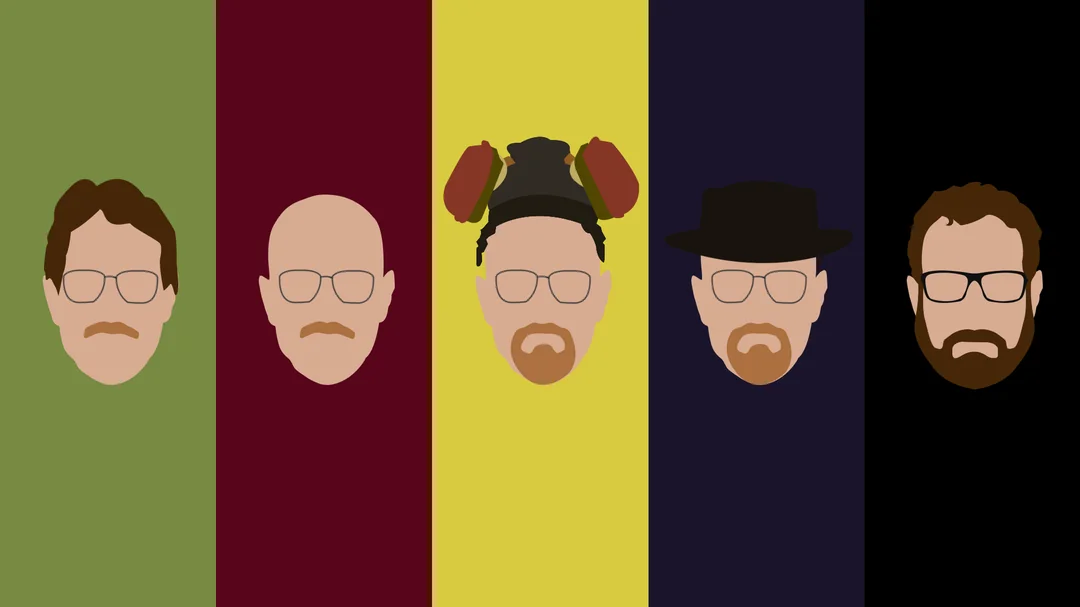
There’s this unforgettable moment in Breaking Bad - Walter White, a mild-mannered chemistry teacher turned drug boss, stands out in the desert, facing a rival who’s never even heard of him. Walt refuses to budge until the guy admits he knows exactly who he’s dealing with.
"Say my name," Walt demands.
The rival hesitates, then finally connects the dots: "You’re Heisenberg."
Walt just says, "You’re goddamn right."
Sure, it’s all ego, but it’s also kind of the holy grail for founders. That moment when customers and competitors know you by name - when you’ve built demand so strong, nobody can ignore you, and there’s no way around it.
Here’s where things get messy. In the startup world, buzzwords fly around like confetti: "network effects," "TAM," "switching costs." Everyone acts like it’s obvious what they mean, but most folks are just nodding along. These SaaS strategy terms end up in the “investor lingo” bucket, until suddenly your fundraising, your roadmap, or even your survival depends on really understanding them.
So, think of this as your cheat sheet. We’ll break down the concepts that actually matter, using the weirdest business school case study you’ll ever see. You don’t need to have watched a single episode of Breaking Bad. By the end, you won’t look at “TAM” or “network effects” the same way again.
The Basics (If You’ve Never Seen the Show)
Breaking Bad follows Walter White, a high school chemistry teacher who gets diagnosed with terminal cancer and decides to cook up an insanely pure (and illegal) product to support his family. Turns out, he’s got serious business chops. Here’s who you’ll meet:
- Walt ("Heisenberg") - basically the founder: genius in the lab, dangerously ambitious.
- Gus Fring - Walt’s rival, runs a fast-food chain called Los Pollos Hermanos as a front for a much bigger operation. The organized operator.
- Saul Goodman - the sleazy lawyer connecting buyers and sellers of questionable goods.
- Gray Matter - Walt’s old company; he sold his stake for peanuts and watched it turn into a billion-dollar empire. He never let it go.
Forget the crime and ethics - it’s a clean look at entering markets, competition, defensibility, and what happens when you mess up. No spoilers except what’s needed for the lesson. Let's get into it.
Part 1: Market Sizing - How Big Is the Empire, Really?
Before you build anything, you’ve got to ask: how big is this opportunity? Get it wrong and you’re building for a market that barely exists, or you’re pitching so big an investor stops taking your calls. Enter TAM, SAM, and SOM - three acronyms founders love to toss around.
TAM, SAM, and SOM (Total, Serviceable, Obtainable Market)
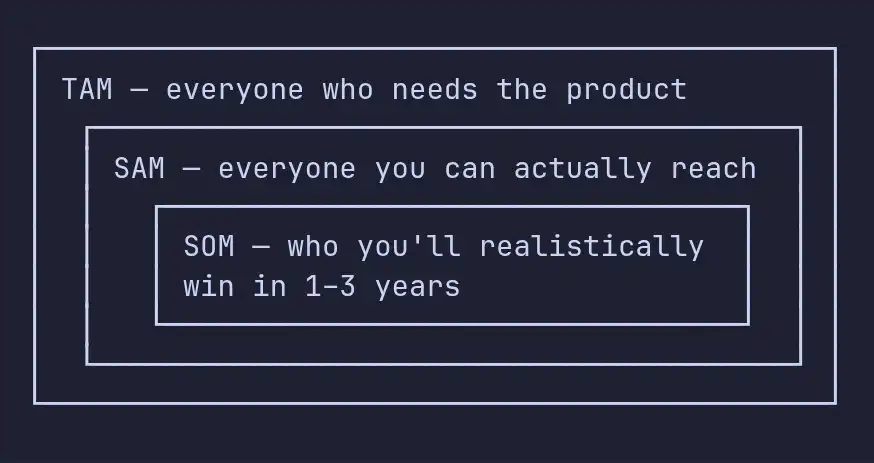
What’s the deal? These terms describe your market in three overlapping circles - from wild dreams to honest reality:
- TAM (Total Addressable Market) - all the money spent in your category if you owned everything. The whole pie.
- SAM (Serviceable Available Market) - the portion you could actually reach based on what you’re selling, where you’re selling, and how. The pie you can touch.
- SOM (Serviceable Obtainable Market) - the slice you could really win over in the next few years, with your resources and competition. The part you’ll actually eat.
Why it matters. Way too many pitch decks act like TAM (total addressable market) is just future revenue waiting to be claimed. It’s not. Saying “Healthcare is a $4 trillion market” doesn’t help investors size up a diabetes app - it just shows you didn’t bother with the math. What serious investors want to see is a bottom-up SOM (serviceable obtainable market): how many real customers, times how much you actually charge. Most B2B SaaS founders can make a believable case for capturing maybe 1–5% of their SAM (serviceable available market) in three years. If you’re aiming higher, you better have a wild (but believable) story to back it up.
Breaking Bad. Take Walt’s product. His TAM spanned billions of dollars - huge, and honestly useless to him, since he couldn’t ship to New York out of a New Mexico lab. His SAM was the Southwest - the region he could actually reach. But his SOM? That’s just what two people could physically make each week. On Breaking Bad, the big problem was never demand. It was always supply. Walt is floating on a giant TAM, and yet he can barely cover SOM.
SaaS translation. Picture a startup pitching with, “We’re going after the $100B productivity software market” (that’s TAM). But if they’re selling only to English-speaking engineering teams of 10–200 people, SAM is way smaller. And in year one, a tiny two-person team can maybe close a few thousand of those teams - that’s their SOM, and really, that’s all the number you need for hiring and burn planning.
Key takeaway. TAM gets you a meeting. SOM gets you a check. Go narrow - build your plan around the smallest realistic market you can actually conquer, and know exactly what’s going to limit you: maybe it’s sales muscle, onboarding, geography, or compliance headaches.
Not sure how big your real obtainable market is?
We've helped SaaS founders pressure-test the TAM-SAM-SOM math before committing real engineering budget - separating the number that lands a meeting from the one you can actually build for and win over the next 12–18 months.
Book a free scoping call and we'll map your beachhead to a realistic SOM, then to the smallest product that can actually capture it - with a budget and timeline to match.
Part 2: Go-to-Market and Expansion - Pick Your Territory
A giant market alone isn’t a plan. Where you start, when you jump in, and whether you’re entering a crowded field or starting something brand new - those are the things that actually matter. Beachhead, timing, and category creation are your lenses.
Beachhead Strategy
What it means. A beachhead is the smallest market you can completely dominate, used as a launchpad to expand into adjacent ones. The term is borrowed from military strategy - you secure one stretch of hostile shoreline before pushing inland - and Geoffrey Moore made it famous for tech in Crossing the Chasm, still the most-cited go-to-market book ever written.
Why it matters. Most founders feel like they’re supposed to go as big as possible right away. Ambitious, right? But if you do that, you risk never being the winner anywhere. It’s better to own a tiny segment, get reference customers, generate word-of-mouth, and toughen your product with real feedback. That’s the fuel for winning the next, bigger circle.
Breaking Bad. Walt didn’t try to become a national supplier. He started by dominating Albuquerque - made his brand the only one that locals wanted. Then he grew to the Southwest, then through partners, and finally to overseas deals. Everything started with taking over just one city.
SaaS translation. Facebook? Not “everyone with an email address” - just Harvard, then the Ivy League, then all universities, and only later the world. Stripe didn’t go after every online business - they began with developers at YC-backed companies. The only reason expanding worked for these companies is that they crushed their tiny starting market first.
Key takeaway. Pick a beachhead so specific it almost feels absurd. Like, “dental practices in Texas” wins every time over “small businesses.” Absolutely control it - and expand from there. It’s much better to own a market than just float inside it.
Market Timing
What it means. Market timing means: Is the world actually ready for this product right now? That’s the “why now?” every investor asks, and way too many founders don’t answer honestly.
Why it matters. Studies on startup success keep landing in the same place - timing outshines both “the idea” and “the team.” Launch too early and you’ll waste everything just educating the market. Too late, and you’re clawing at whatever the big incumbents didn’t already claim.
Breaking Bad. Walt’s old tragedy is a timing story. He helped start Gray Matter, sold his shares for five grand, and watched it become a billion-dollar behemoth. Right guy, wrong moment (disastrously so). The whole show? It’s Walt trying to replay that bet, but with “better” timing.
SaaS translation. Webvan threw down $400 million in 2000 to do what Instacart nailed in 2012 - deliver groceries. The difference? By 2012, smartphones existed and people actually trusted online orders. Same idea, but a decade later the tech and consumer trust were there, and boom - suddenly it worked. Same thing happened in AI: a bunch of “AI assistant” startups crashed in 2017, then near-identical concepts took off once big language models matured in 2023 - which is exactly why building AI agents into SaaS only started genuinely working in the last couple of years.
Key takeaway. Have a sharp, specific answer to “why now?” - show what just changed to make this possible today (tech, new laws, price drops, new habits, whatever). If all you’ve got is “big market,” then chances are, you’re just too early. And too early is basically the same as wrong - until the world catches up.
Category Creation
What it means. Category creation means you invent not just a new product, but a whole new bucket for products - a new category with a new name. Not just a better CRM; you create “revenue intelligence.”
Why it matters. If you create the category, you write the rules and become the name people know. But teaching an entire market a new idea (and a new name) is slow, hard, and expensive. It’s worth noting the vast majority of winning companies just found an existing category and outperformed everyone else.
Breaking Bad. Walt didn’t invent meth - but his was so pure, so distinctive, so visually unique, he basically created a category inside that world. His competitors? They tried to copy his trademark blue color just to ride his reputation. That’s leadership: rivals reshaping their businesses around your defining feature.
SaaS translation. Salesforce coined “cloud CRM” with a bold “No Software” rallying cry. HubSpot pushed “inbound marketing.” Gong went all-in on “revenue intelligence.” These companies named categories and became their defining examples. But for every Gong or HubSpot, hundreds of companies died out trying to invent new names the market didn’t care about.
Key takeaway. Category creation is high-stakes. Only chase it if your product is truly one-of-a-kind and you’re ready to spend years (and a lot of cash) on education. Otherwise? Win in an existing market by being flat-out better than everyone else. That path works just fine for building an empire.
Part 3: Competitive Dynamics - Build a Moat or End Up Roadkill
Getting early traction feels great. Holding onto it? That’s the nightmare. There’s a huge gap between a company that keeps growing and one that gets copied into oblivion. That gap is called defensibility - the moat that stops the next clever hustler from ripping off your work. If you’re building anything in SaaS, this is the real conversation about staying alive.
Competitive Advantage
Let’s talk advantage. Not the buzzword, the real deal. A true competitive advantage is why customers stick with you - and not just because you’re cheap or have a quirky feature. It’s something that competitors can’t just stomp out overnight. The magic word: durable. Cut-rate pricing isn’t an advantage; that’s just an invitation for a race to the bottom. Durable means you have something foundational: unique data, deep expertise, scale that no one else can touch.
Why sweat this? Because today’s hot product is tomorrow’s feature on someone else’s roadmap. If your edge isn’t real, you’re just renting that early growth. When someone with enough resources shows up, they’ll crush you if all you have is a gimmick.
Let’s bring in “Breaking Bad.” Walt wasn’t feared because he was ruthless; he was irreplaceable because his product blew everything else out of the water. The blue stuff wasn’t branding - it was a visible gap in real quality. Distributors didn’t work with Walt out of fear, they needed his product to keep their customers. That’s the difference: you have to be necessary, not just popular.
What does this look like in SaaS? AWS dominates because its sheer scale means infrastructure is cheaper, more reliable, and faster for them than nearly anyone else. That keeps widening the gap. Figma? They cracked real-time, browser-based collaboration when no one else could come close. Those are advantages with teeth. They’re deep, not cosmetic. Copying the interface isn’t enough.
So, ask yourself: if a well-funded clone ships your app tomorrow, why do your customers stay? If you can’t answer, you don’t have a moat - you have features. Your job? Find what only you can say for real, and build so customers repeat it.
Barriers to Entry
Now, let’s talk about what makes it tough for new entrants to even show up. Barriers to entry are those hurdles that slow down or block fresh competition. Sometimes it’s tons of capital, crazy technical challenges, strict regulation, or just a mountain of accumulated data.
If the bar is too low, the moment you prove out a market, a swarm of well-financed copycats will show up. If it’s high, you get to keep running ahead while others are still figuring out the basics or stuck in compliance hell.
Back to "Breaking Bad" - take Gus Fring. Breaking into his level of business needed a secret underground lab, expert chemistry, locked-up chemical supply lines, and even a front in the form of a chicken empire. No newbie could snap their fingers and pull that off. You had to solve all those problems, not just one.
In SaaS, think Stripe. It isn’t just the slick payment form - it’s years of wrangling banks and regulators, building fraud systems, and nailing down global payment plumbing. That’s a wall newcomers slam into. Same story with healthcare software: regulations like HIPAA slow everyone down, but that slog eventually turns into your moat. (This is exactly why we argue for architecting a SaaS platform to pass SOC 2, ISO 27001, and GDPR from day one - so compliance becomes a wall for the next entrant instead of a tax on you.) What seems like a tax early on is what keeps the next startup at arm’s length later.
Bottom line: barriers feel like annoying friction when you start, but eventually, they’re the fortress that keeps you safe. Chase challenges where all the hard, unsexy work turns into real defense.
Switching Costs
Switching costs are everything your customer has to give up if they try to leave you. Money, time, data, or just peace of mind. The higher those costs, the stickier your business becomes - even if rivals try to tempt your customers away.
High switching costs turn a good app into a powerhouse. They’re why some SaaS companies end up with "negative churn" - meaning their current customers spend more and stick around longer than they leave.
In “Breaking Bad,” when distributors anchored their business on Walt’s product, they weren’t just swapping out inventory by switching suppliers. They risked losing their own customers because the quality wasn’t the same. The dependency had fused - changing suppliers became a threat to their own survival.
The SaaS world is full of this. Try pulling out Salesforce after years of customizing, building integrations, and training teams. The project’s so daunting that most companies won’t even consider it - even if they’re grumbling all the way. The data and workflows are the real padlock. That said, AI migration tools are finally loosening some of this lock-in, so don’t get cocky and think you’ll have your customers prisoner forever.
The punchline: Build switching costs that customers appreciate. Give them so much value in integrations, data, and daily workflows that they’re grateful for the lock-in. If you resort to tricks like tough contracts or penalties, you’re just setting yourself up for a future stampede out the door.
Network Effects
Here’s the deal with network effects: your product gets more valuable for every single user as more people jump on board. Think about the telephone - one phone is just a hunk of plastic, but millions? That’s what makes it indispensable.
Network effects are the toughest moat you can build in software. They don’t just hang around - they get stronger as you grow. For a competitor, breaking in isn’t about swiping a few users here and there. They have to tear people away from the whole interconnected group. That’s why investors write the fattest checks for companies with true network effects. But here’s a reality check: having lots of users doesn’t mean you have a network effect. The real question is, does user #1,000 make the experience better for user #1?
Let’s look at Breaking Bad. People always talk about Walt’s blue meth like it was unstoppable, but honestly, his success wasn’t about network effects. He had a killer brand and high switching costs, sure, but one customer buying didn’t make things better for anyone else. That was Walt’s weakness; his entire business hung on a recipe and a person. Anyone else with those ingredients could take his spot. Gus saw this coming, and quietly lined up a backup chemist for exactly that reason. If there was any network effect in Walt’s world, it came from distribution - adding territory meant new partners got more value, and replacing him got harder.
Let’s translate that to SaaS. Slack gets better every time a new coworker joins - classic, direct network effect. Airbnb pulls off an indirect one: more hosts mean more guests, and more guests attract more hosts. Simple. Take your average analytics tool, though. Maybe it’s sticky, maybe people love it, but user #10,000? That doesn’t really change life for user #1. That’s still a good business - just don’t play the network effect card on your pitch.
Bottom line: Be brutally honest - do you have a real network effect, or just strong switching costs and a cool brand? Both matter. But only one gets better with every new user. If you confuse them, you can build a strategy - or start fundraising - on quicksand.
Red Ocean vs. Blue Ocean Strategy
Let’s break down the metaphor. “Red ocean" means an existing market lots of competitors, everyone fighting over the same pie, blood in the water. “Blue ocean”? You create an entirely new market space. For a while, you don’t have to care what anyone else is doing. This only works if you actually raise the bar for customers and lower the cost, instead of just trading one for the other.
Why does this matter? In a red ocean, you’re hacking away for every scrap: cutting prices, piling on features, dropping buckets of cash on sales - usually, the biggest bankroll wins. Blue oceans let you carve your own path. But real talk: blue oceans are rare, and most companies win by out-executing their rivals in messy, bloody waters. Knowing which ocean you’re in tells you how to play.
Breaking Bad is pretty much a blood-red ocean, literally. Walt walked into a cutthroat market - dominant players, price wars, and, well, actual violence. A small newcomer going toe-to-toe would get eaten. Walt sidestepped the bloodbath with a blue ocean move - an ultra-pure, premium product that nobody else could match. Price didn’t matter. The competition barely mattered - at least for a while. And yes, it was even blue.
What’s this look like in SaaS? Launching “yet another CRM” or “another project management tool” is jumping into a red ocean, squaring off with giants. AWS made a blue ocean by turning pricey, clunky servers into pay-as-you-go tools. Figma found a way to stand out in the crowded design-tool market by going browser-first and real-time collaborative. Both changed the rules, instead of fighting over the old ones.
So, if you’re jumping into a red ocean, you’d better come ready to fight and have the cash to survive. Find a blue ocean, change the rules, and you get a lot more room to breathe. Just make sure the water really is blue before you jump in - sometimes you just haven’t spotted the sharks yet.
Where do your moats actually live? Usually in the architecture.
Switching costs, proprietary data, and network effects aren't marketing lines - they're built or lost in your data model, multi-tenancy, and integrations. We've architected SaaS platforms where defensibility is baked into the technical foundation instead of bolted on after the copycats show up.
Book a free scoping call and we'll map where your competitive advantage should come from, and how to build it into the product from day one - without overengineering.
Part 4: SaaS Business Models - What Kind of Empire Are You Building?
You can take the same product and build totally different businesses around it. The way you package and sell it changes everything: think profits, risks, and how hard it is for someone to knock you off your throne. Most of the confusion in SaaS comes down to four big business model types: vertical vs. horizontal, platforms, marketplaces, and aggregators.
Vertical vs. Horizontal SaaS
Here’s the gist. Horizontal SaaS handles one thing like email, payroll, or a basic CRM for every industry out there. Vertical SaaS, on the other hand, tackles a whole bunch of pain points, but just for one industry. Maybe it’s software made just for dentists, or for construction companies, or that one restaurant system jam-packed with features no one else needs.
Why care? Well, if you go horizontal, you’re fishing in a much bigger pond. That means more potential customers, sure… but also way more rivals. Plus, it’s not that hard for customers to leave you for someone else. With vertical SaaS, your pond’s smaller but way deeper. The software gets wrapped around workflows, compliance, and even financial tools unique to one industry. It’s a tougher business - harder for competitors to break in, harder for customers to rip you out. Picking between vertical and horizontal isn’t a small thing. If you want the full breakdown, see our vertical SaaS deep dive.
Think about Breaking Bad. Walt built a vertical business one product, one market, total mastery. Then there’s the German conglomerate in the background, buying up everything from fast food to logistics to chemicals. That’s the horizontal model: spread wide across many industries. Walt went deep; the conglomerate went broad.
Who’s doing what in SaaS? Look at Veeva, Toast, Procore they each dominate one industry so thoroughly that a generalist competitor adding a “healthcare option” doesn’t stand a chance. Slack, Notion, and Salesforce’s core CRM? That’s horizontal. They sell to everyone, but the competition’s brutal.
Bottom line: It’s not about dreaming small or big - vertical just means your strong point is deep industry know-how. Own your niche and you can dig a moat nobody wants to cross. Horizontal can win too, if you’re after something everyone needs and you can out-execute the pack. Just know you’ll fight harder for every inch.
Platform Models
A platform is simple in theory: you build the foundation; everyone else builds what sits on top. You provide the tools, rails, and audience - other companies use those to make their own products, which makes your platform more useful for everyone.
Why this matters: When you own the platform, outside developers can build value for your ecosystem. Your business grows while they do the work. But guess what? If you’re the one building on someone else’s platform, you’re always living with one eye on the rulebook. They can change the game any time: new fees, new rules, or just pull the plug.
Remember Gus from Breaking Bad? He owned the platform: labs, trucks, even a fast food chain for cover. Walt was just a supplier, stuck playing by Gus’s rules, and he hated living with that kind of risk. Turns out, Gus already had Walt’s replacement lined up. That’s what platform risk feels like - huge upside, but you could lose everything if you don’t own the rails.
In SaaS, think about Salesforce’s AppExchange or Shopify’s app store: whole economies sprung up around those platforms. The flip side? There’s a long list of startups that bet everything on social or API platforms - then got crushed when the platform changed the terms. Building a platform is powerful; depending on somebody else’s platform is trusting that the roof over your head won’t vanish overnight.
Bottom line: Controlling a platform means you’re in the driver’s seat. Renting someone else’s comes with a built-in risk you can’t ignore. If a third party can kill your business with one decision, face that risk head-on and find ways to cut it down.
Marketplaces
A marketplace brings buyers and sellers together and takes a cut - simple as that. You don’t own the stuff that moves through the network; you own the trust, the match, the payments, and sometimes a place for reviews. Inventory isn’t yours. Relationships are.
Marketplaces can grow fast since you’re not out there buying cars or renting rooms yourself. But here’s the catch - the infamous chicken-and-egg problem. Sellers want buyers waiting, buyers want stuff to buy, and you need both sides to show up at the same time. Honestly, most marketplaces fail right here. Figuring out how to get things moving - cold-start liquidity - is pretty much the entire job early on (we dig more into this in our marketplace development guide).
Back to Breaking Bad: Saul Goodman’s a living, breathing marketplace. He connects people who need questionable services with people who can provide them. No inventory, just deal-making and a fee each time. The guy is pure matchmaking.
In SaaS, think Airbnb connecting guests and hosts, Uber with drivers and riders, Upwork where freelancers meet clients. None of them own the rooms, cars, or labor - they own trust, payment rails, and the crowd. The hardest part is never building the software, it’s getting enough activity on both sides at the same time.
Bottom line: If you’re building a marketplace, your number one problem is always kickstarting supply and demand. Get that flywheel spinning, and the code is just table stakes. The real game is making sure there’s enough action on both sides to keep it all moving. That’s where almost every marketplace stumbles.
Aggregators
What’s an aggregator? Ben Thompson’s Aggregation Theory nails it: an aggregator wins by owning demand - not supply. The aggregator controls the customer relationship so thoroughly that suppliers have no real choice but to play by its rules. The suppliers end up as commodities - interchangeable, replaceable, squeezed for margin.
Why does this matter? Because it’s the single strongest spot in today’s economy. In the old days, companies won by locking up scarce supply. Think newspaper printing presses, or shelf space in a grocery store - control those, and you control the money. Aggregators flipped it. They capture demand, at almost zero extra cost, then call the shots with a crowd of powerless suppliers. If you go head-to-head with an aggregator… good luck.
Breaking Bad puts this in neon lights. When Walter White says “say my name,” he’s not just showing off. By that point in the series, Walt owns the demand. Buyers want his product - and only his product - by name. Distributors need him, not the other way around. He’s turned the big, scary distributors into a bunch of anonymous cogs. That’s aggregator power: you lock up demand so tightly that everyone up the supply chain is just plug-and-play.
What about SaaS? Same playbook. Google owns search demand; every website bends over backward to please it. Amazon owns shopping demand; sellers take whatever deal Amazon gives them. Booking.com owns travel demand; hotels fork over a fat cut. Sure, websites, sellers, and hotels all matter - but they’ve lost the way to the customer’s heart. That scarce moment when a person actually wants to spend or decide? The aggregator’s got it on lockdown.
Bottom line: Ask yourself - who owns the demand in this market? If the first thing a customer does is fire up a specific app, or type in a specific site, that company calls the shots. Everyone else - even if they make the stuff people buy - is playing defense. The real prize isn’t making products. It’s owning those minutes, those moments, when someone actually cares.
How These Concepts Actually Shape SaaS Companies
These aren’t just vocabulary words to memorize. They’re interconnected, and every real decision in SaaS pulls on several of them at once.
When you pick target customers, you’re really doing market sizing and finding your beachhead. You want a big enough slice to matter but small enough to actually win, so you go deep into the SOM and dominate there first. The teams that chase TAM - “our market is everyone!” - usually end up with nothing.
When it comes to prioritizing your roadmap, switching costs and network effects matter more than flash. A feature that makes your product stickier, or one that gets better as more users join, grows in value over time. Compare that to a dazzling new feature a competitor can copy in a couple weeks. I’ve watched teams burn months on stuff that looks good in a demo but doesn’t actually build real defensibility.
Expanding is always about balancing beachhead and timing. Go too early - before you’ve wrung out your beachhead - and you’re spread thin with no base to show for it. Wait too long and a faster rival will grab the next adjacent market before you even notice. The signal to move on is simple: you’ve squeezed the juice out of your beachhead, not that some new market looks tempting.
When a competitor shows up - and if you’re any good, they will - it’s all about walls: regulation, data, economies of scale, or an ecosystem. If you’ve got those in place, new entrants bounce off. If not, they walk right in. So put your defenses up now, not after the copycats arrive.
Building true advantages is about piling up moats. Vertical depth (solve a whole workflow), switching costs (make it painful to leave), and network effects (each new user makes it better for everyone). No single moat is enough, but a good stack is hard to beat.
Honestly, when I look at a new SaaS idea - mine, a client’s, doesn’t matter - these are my questions: Why now? Where’s the beachhead? What actually makes it sticky? Can it fend off a rush of clones? Who has demand? If an idea can’t answer these, it’s just a hopeful feature, not a real strategy.
Got the strategy - now need the platform to back it up?
Vertical SaaS, a marketplace, a platform others build on - the model you pick changes how everything underneath it gets architected, and each one gets hard in a different place. We've shipped all three and know where the traps are.
Book a free scoping call and we'll translate your strategy into the right technical approach, with a realistic budget and timeline - so you don't overbuild or underspend.
Conclusion: Learn the Rules First
All these ideas - TAM, beachhead, switching costs, network effects, aggregators - sound like boardroom B.S. until they hit you in real life. But each one is a real force. You ignore them, they won’t ignore you.
You can launch early and realize nobody cares for three years. Shrug off switching costs, and another company will poach your customers the second they offer a better rate. Laugh at “who owns demand” - until you’re the faceless supplier and someone else is squeezing your margins. These aren’t electives. They’re gravity.
The founders who win aren’t the smartest, or the richest, or the best at writing code. They’re the ones who actually learned the rules before the game started. They found a niche and owned it. They started building moats before the market got crowded. When people talked about their space, their company’s name was the first thing that came up.
Just look at Walter White. Brilliant chemist, clueless strategist. He built one great product after another, but it never lasted. He sold out early at Gray Matter for pocket change. Later, he built an empire on meth but never built a real moat. A great product? That’s what gets you in the door. A great strategy is why you actually stay.
When a competitor shows up, you shouldn’t have to introduce yourself. People should already know your name.
Say it, and mean it.
At Conception Labs, we build SaaS platforms - and we think about this strategy layer while we're architecting them, because the technical choices (multi-tenancy, integrations, data models) are where switching costs and moats are actually made or lost. If you're working through where your defensibility comes from while building the product itself, we've navigated this a few times and would enjoy comparing notes. Start with our complete guide to custom SaaS development if you want the technical companion to this strategic one.