

Marketplace platforms have exploded over the last decade. They now control two-thirds of global online sales. Not a small jump, considering it was just 40% ten years ago. Last year, the top 100 marketplaces handled a jaw-dropping $3.5 trillion in gross merchandise value. If you zoom in on Amazon, third-party sellers alone brought in $575 billion almost 70% of Amazon’s entire sales. The numbers don’t lie: more founders than ever are eyeing multi-vendor marketplaces.
But is building one the right move for you? Well, there’s a reason founders keep asking. The marketplace model is a force of nature when it goes right. Network effects make growth exponential. You don’t hold inventory or ship orders your vendors do all that. Your platform connects the dots and collects a cut. Simple on paper, but reality is tricky. Most marketplace startups about two-thirds don’t make it.
Why?
They either try to build everything (way before proving anyone wants it) or run straight into the dreaded cold-start: no buyers, no sellers, and no clear way to fix it.
We’ve seen these pitfalls up close, whether B2C, B2B, or mixed models. That’s why this guide leaves nothing out. We’ll walk through critical business choices that change your entire technical approach, what the architecture actually needs to support, the real pros and cons of buying vs. building, what you’ll actually spend (and how long it takes), plus all those operational headaches that no amount of pretty code will solve.
What Sets a Marketplace Apart from a Regular Store
A multi-vendor marketplace puts lots of independent sellers on one stage, so buyers can find everything in one spot. You, the operator, don’t stock anything yourself. Instead, you handle tech, search, payments, and set the ground rules for trust and disputes. You make money by making transactions happen not by selling or shipping goods.
It’s a totally different beast than running your own online store with Shopify. If you’re a single brand, your big problems are supply chain and logistics. When you’re running a multi-vendor marketplace, you’re managing a network. It’s all about connecting the right buyers and sellers, not just moving your own product. (If you’re weighing this against a single-brand store, our D2C ecommerce platform development guide walks through the other side of the decision.)
Let’s break it down further:
| Dimension | Single-Vendor Store | Multi-Vendor Marketplace |
|---|---|---|
| Inventory | You own everything | Vendors own the goods |
| Revenue model | Product margin | Commissions or fees |
| Scaling challenge | Supply & logistics | Getting enough buyers AND sellers (liquidity) |
| Payment flow | Direct to you | Split payments across parties |
| Trust burden | Single brand covers risk | Platform mediates between strangers |
| Data complexity | Simple product catalog | Messy, varied catalogs normalized for search |
What’s powerful here is scale with less capital outlay. Amazon doesn’t own the hundreds of millions of products on its site; third-party sellers do. Etsy’s millions of sellers create and ship their own handmade goods. The magic is in making buying and selling as smooth as possible and your tech has to be built for that.
How Marketplace Business Models Actually Make Money
How you make money changes what you have to build. Pick the wrong model, and you could over engineer payments, or worse, miss out on the real opportunity.
Commission-Based (Take Rate)
This is what most marketplaces use. You take a cut from every sale. Amazon’s share is anywhere from 8% to 15%, depending on category. Etsy takes 6.5%. Faire gets up to 25% on first orders.
What you need tech-wise: Split payments. You need funds to hit your account and seller accounts automatically. Stripe Connect is a popular choice here.
Best fit: High volume, lots of repeat purchases, predictable transaction values.
Subscription or SaaS Fee
Here, sellers pay a flat monthly fee to use your marketplace, no matter how much they sell. Etsy has a $15/month Plus tier. Amazon charges pros $39.99 a month.
Tech requirement: Recurring billing, managing who’s on which plan, and unlocking features accordingly.
Best fit: Works well when your platform brings enough value-buyers, tools, data that sellers stick around even if their sales drop. Most successful as an add-on, not the only model.
Listing Fees
This means charging sellers per product they upload. Etsy takes 20 cents per listing; B2B marketplaces sometimes charge by catalog.
Tech requirement: Track listings and bill accordingly. You have to know what’s active, expired, or needs renewal.
Best fit: When categories have big catalogs and you want to nudge only serious sellers to upload. Also keeps spam and junk off your platform.
Freemium + Premium Placement
Let anyone list for free, but charge for extras like promoted spots, featured listings, or access to detailed analytics. Just look at Amazon: their Sponsored Products and Sponsored Brands ads have turned into a multi-billion-dollar business.
Technical requirement: You’ll need an ad-serving setup, bid management, good tracking for impressions and clicks, and reporting dashboards.
When it works: This only pays off once you’ve got serious traffic. It’s not worth building for your MVP.
Hybrid (The Answer for Most Marketplaces)
Most successful marketplaces mix and match revenue streams. Take Etsy they collect listing fees, take a commission, offer subscription tiers, and sell promoted listings. Start with something simple like a commission, then add other ways to make money as you grow.
Pro Tip: Go commission-only for your MVP. This keeps things fair you only earn when your sellers do, which makes it easier to earn their trust when you’re trying to convince them to sell on your brand-new platform. You can add subscriptions and advertising once you’ve proven people actually want what you’re building.
Still deciding on the right marketplace business model?
We've helped marketplace founders across B2C, B2B, and service verticals pick monetization models that match their liquidity stage - without over-engineering billing, payouts, or ad platforms you won't need for a year.
Book a free scoping call and we'll map your revenue model to the right MVP feature set and tech stack.
Core Feature Set: MVP vs. Scale
One of the most common mistakes?
Trying to build a “fully featured” marketplace before you’ve shown that both buyers and sellers actually want to use it. Here’s what you actually need for launch, and what can wait.
MVP (Launch-Ready) Features
Vendor onboarding & management
- Self-serve sign-up with some kind of business verification
- Store profiles logo, descriptions, shop policies
- Product listing tools (upload images, write descriptions, set prices and variants)
- Dashboard for managing orders, tracking shipping, seeing fulfillment status
- Payout and earnings view
Buyer experience
- Search with basic filters (like category, price, vendor rating, location)
- Product pages that clearly show the seller
- A unified cart that lets buyers shop from several sellers at once
- Checkout that handles splitting payments between vendors
- Track orders even when they’re coming from different sellers
Platform administration
- Approve vendors manually at first don’t automate this yet
- Manage categories and taxonomy
- Set platform commissions
- Handle simple disputes and refunds
- See basic stats: GMV, take rate, active vendors/buyers
Trust & safety
- Customer reviews and ratings for both products and sellers
- Basic fraud checks (suspicious velocity, address mismatches)
- Make sure sellers agree to your terms and conditions
Scale Features (Post-PMF)
These are important, but not until you’ve proven real market fit. Building them too early just means wasted time and cash.
- AI search and recommendations for personalized discovery, “semantic” search, and things like “customers also bought” Amazon says these drive about 35% of purchases.
- Advertising tools-sponsored spots, promoted listings, auctions for placement.
- Advanced analytics: conversion funnels, traffic sources, competition benchmarks for vendors; cohort analysis and liquidity tracking for admins.
- Automated vendor scoring: algorithms to rate sellers on things like ship speed, returns, response time, review quality.
- Built-in chat and messaging for buyers and sellers, plus simple ways to mediate disputes.
- Multi-currency and language must-haves if you’re going global.
- Logistics integration: things like instant shipping label printing, rate comparison, even a “fulfilled by your platform” setup.
- Loyalty or rewards like points or repeat buyer incentives.
Pro Tip: Build only what proves your unique value. If you’re promising curation (like Faire), focus your MVP on onboarding quality brands and clear category rules skip the ad platform for now. If it’s about price comparison (like Google Shopping), put energy into normalizing product data and building flexible search. Your differentiator should lead your roadmap.
Technical Architecture Deep-Dive
This is where things get tricky. The structure you choose now will control how fast you scale, how much you spend running things, and how easy or painful future development gets.
Architecture Pattern: Start Modular, Extract Later
Teams sometimes sink six months into fancy setups spinning up Kubernetes, wiring microservices when they don’t even have their first vendor live. Skip that.
recommendation: Begin with a modular monolith. That means one codebase and one deployable app, but with clear boundaries between modules like vendor management, catalog, orders, payments, search, and notifications. They all use one database, but each part talks through specific internal interfaces. It’s simple to start and doesn’t box you in for later.
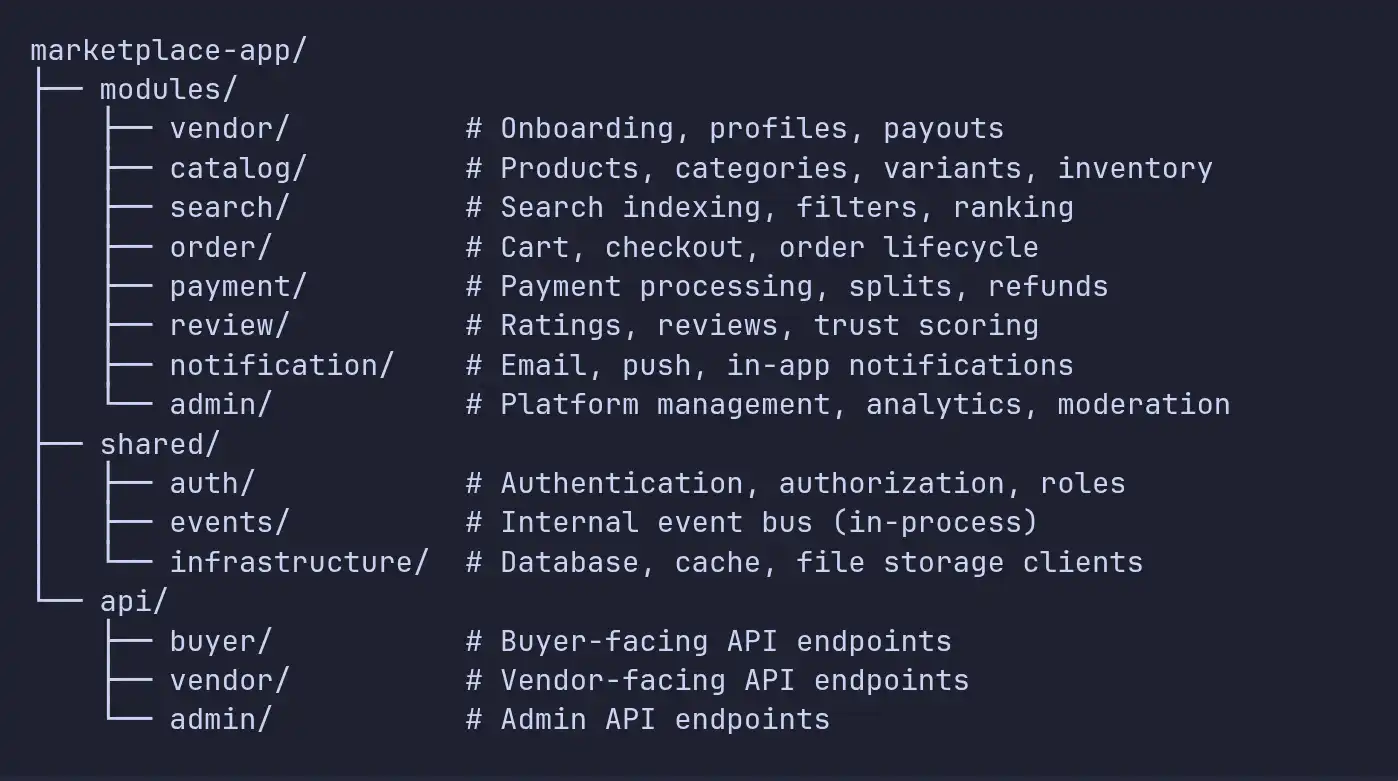
You get all the perks of microservices clean separation of concerns without drowning in extra operational work. If one part of your system starts slowing things down (search is usually the troublemaker), just pull it out into its own service. You’ve already set up the internal boundaries, so splitting things off comes easy.
Don’t even start thinking seriously about microservices until you’re seeing around $10 million in GMV or your team grows past 8 or 10 engineers all working on the platform at once. Before that, stick with simpler architecture.
Database Design: Multi-Tenancy for Marketplaces
Database design is another big deal, especially with marketplaces. You need to keep each vendor’s data separate but still let your system run cross-vendor searches and analytics. For most marketplaces, start with a shared database using row-level isolation.
PostgreSQL nails this with its Row-Level Security (RLS) policies:
-- Every vendor-owned table includes a vendor_id column
CREATE TABLE products (
    id UUID PRIMARY KEY DEFAULT gen_random_uuid(),
    vendor_id UUID NOT NULL REFERENCES vendors(id),
    title TEXT NOT NULL,
    description TEXT,
    price_cents INTEGER NOT NULL,
    currency VARCHAR(3) DEFAULT 'USD',
    status VARCHAR(20) DEFAULT 'draft',
    created_at TIMESTAMPTZ DEFAULT NOW(),
    updated_at TIMESTAMPTZ DEFAULT NOW()
);

-- RLS policy: vendors only see their own products
ALTER TABLE products ENABLE ROW LEVEL SECURITY;

CREATE POLICY vendor_isolation ON products
    USING (vendor_id = current_setting('app.current_vendor_id')::UUID);

-- Admin and buyer queries bypass RLS via separate roles
-- with broader read permissions
Key things to keep in mind when designing:
- Normalize your product data and do it aggressively if you want search to work. Vendors will send you all kinds of inconsistent information. Set up a canonical schema and make sure everything they submit fits into it, no matter how messy the original data.
- Split your read and write models from the start. The way vendors update their listings (writes) has totally different needs than the way buyers browse the catalog (reads). This isn’t full-on CQRS, but it means thinking separately about how you handle updates versus searches.
- Expect your inventory to be eventually consistent. Let’s say two people try to buy the last item at the same time. You need to deal with that without everything falling apart. Optimistic locking with clear rules for conflicts usually does the trick, especially at MVP stage.
Search infrastructure
Search really is the cornerstone of a multi-vendor ecommerce platform. Your catalog’s going to be all over the place vendors write product details differently, use different images, and sort things in inconsistent ways.
For your MVP, go with Elasticsearch or OpenSearch, and build an index that normalizes product details from the start. You’ll want:
- Faceted search so people can filter by stuff like category, price, vendor rating, or location
- Fuzzy matching and smart handling of synonyms
- Relevance tuning: boost results by vendor reputation, how recently something was added, or how well it converts
- Solid autocomplete people expect it now
When you scale up, you might want to look at Algolia if you prefer off-the-shelf solutions, or stick with OpenSearch and build your own ranking. AI-driven semantic search is quickly becoming the norm vector embeddings for better product discovery are expected. Fun fact: by 2025, 77% of e-commerce pros use AI in their daily work (EComposer). That’s not a trend it’s the baseline.
# Example: Simplified Elasticsearch product index mapping
product_mapping = {
    "mappings": {
        "properties": {
            "title": {
                "type": "text",
                "analyzer": "standard",
                "fields": {"keyword": {"type": "keyword"}}
            },
            "description": {"type": "text", "analyzer": "standard"},
            "category_path": {"type": "keyword"},
            "price_cents": {"type": "integer"},
            "vendor_id": {"type": "keyword"},
            "vendor_rating": {"type": "float"},
            "attributes": {"type": "nested"},
            "embedding_vector": {
                "type": "dense_vector",
                "dims": 768,
                "index": True,
                "similarity": "cosine"
            },
            "created_at": {"type": "date"},
            "is_active": {"type": "boolean"}
        }
    }
}
Payment Orchestration: The Hard Part
Split payments are where marketplaces get tricky. Imagine a shopper buys things from three different sellers in a single checkout. The platform needs to charge the buyer once, then break up that payment between each vendor after taking its own cut, of course. You also need to hold onto the money until the orders go through, deal with partial refunds if just one part of the order goes wrong, and pay out each seller on whatever schedule you’ve chosen maybe daily, weekly, or monthly.
Stripe Connect basically runs this show. About 75% of the biggest marketplaces use it (Stripe, 2025). Stripe takes care of onboarding vendors and making sure everyone’s legit. It splits payments, lets you set up commissions, handles delayed payouts if you want to hold funds for a bit, and supports multiple currencies. For US sellers, it even manages 1099 tax reporting. Instant payouts are getting more popular, too up 27% last year.
PayPal for Marketplaces or Adyen for Platforms work too, especially if your vendors or customers live in areas where Stripe isn’t a great fit. (For a deeper look at webhook handling, PCI scope, and multi-provider checkout patterns, see our ecommerce payment integration guide.)
// Stripe Connect: Creating a payment intent with split
const paymentIntent = await stripe.paymentIntents.create({
  amount: 10000, // $100.00 total order
  currency: 'usd',
  payment_method_types: ['card'],
  // Transfer to vendor after successful payment
  transfer_group: `order_\${orderId}`,
});

// After payment succeeds, create transfers to each vendor
await stripe.transfers.create({
  amount: 4250,  // $42.50 to Vendor A (after 15% commission)
  currency: 'usd',
  destination: vendorA_stripeAccountId,
  transfer_group: `order_\${orderId}`,
});

await stripe.transfers.create({
  amount: 4250,  // $42.50 to Vendor B (after 15% commission)
  currency: 'usd',
  destination: vendorB_stripeAccountId,
  transfer_group: `order_\${orderId}`,
});
// Platform keeps $15.00 commission ($7.50 × 2)
Real-Time Features
Marketplaces have to move fast. Here’s what real-time actually means for you:
- Inventory sync: No one wants to double-sell. If a vendor’s on Shopify and your platform, keep the counts in sync.
- Order notifications: When an order comes in, vendors need to know right away not fifteen minutes later.
- Chat/messaging: Buyers and sellers expect to talk, not wait for an email reply that gets lost.
- Live admin dashboards: You want to see GMV, orders, vendor activity, all as it happens.
For anything your users interact with in real time (like chat or instant notifications), go with WebSockets Socket.IO is popular, or you can use native WebSockets. When it’s about backend modules talking to each other? Start simple: an in-process event bus. If things get busier or you want to spread out workloads, switch to Redis Pub/Sub or something heavy-duty like RabbitMQ or Amazon SQS.
Not sure which marketplace architecture fits your business?
We've helped D2C brands, B2B wholesalers, and marketplace founders pick the right ecommerce architecture without overbuilding or underspending.
Book a free scoping call and we'll map your requirements to the right approach, with a realistic budget and timeline.
Build vs. Buy: The Real Choice
This is make-or-break for your marketplace. Here’s how it really shakes out. (The framework we use for single-vendor ecommerce in our custom ecommerce build vs buy guide applies here too - marketplaces just add extra weight to payments and compliance.)
Option 1: Build Custom
Hire a team, roll your own. You get total control, but you pay for it money, time, and brain cycles.
Best for: Marketplaces with new mechanics, out-there user flows, or stuff that just doesn’t fit “standard” software. Think of platforms with unusual financial flows like Faire with its net-60 terms for retailers, or StockX with authentication and live bidding baked in. If your marketplace lives or dies by a unique flow, build it yourself.
Option 2: Open-Source Platforms
Take a solid open-source platform and reshape it.
- Sharetribe: Perfect for MVPs. Hosted version (Web) and open source (Flex). Vendor onboarding is easy, Stripe Connect is already wired in.
- Medusa.js: Headless, Node.js-based commerce framework. Great for devs, solid flexibility.
- Saleor: GraphQL from the ground up. Modern stack, headless-friendly.
Best for: Marketplaces in proven spaces rental, service, physical goods who want speed and will stand out with curation, community, or branding, not fundamental mechanics.
Option 3: Enterprise SaaS (Marketplace-as-a-Service)
Buy the whole foundation so you just configure, not code.
- Mirakl: This is the gold standard if you’re big. Macy’s, Kroger, Best Buy use it. Big price tag, but proven and runs about $15B in GMV (2025).
- Arcadier: Cheaper, good for B2B or niche cases.
- CS-Cart Multi-Vendor: Self-hosted, license model. Costs less, but you do more tech grunt work.
Best for: Retailers who have e-commerce but want to flip on a marketplace channel fast. If in-house development or differentiation isn’t your edge, this saves you months.
Comparison Matrix
| Factor | Custom Build | Open-Source | Enterprise SaaS |
|---|---|---|---|
| MVP cost | $100K–$350K+ | $30K–$100K | $50K–$200K/year |
| Time to MVP | 4–9 months | 6–12 weeks | 4–8 weeks |
| Flexibility | Limitless | High (needs dev) | Limited to product |
| Scaling cost | Add infra & team | Add infra & team | Tiered pricing (gets pricey) |
| Maintenance | All on you | You + community | Mostly on vendor |
| Vendor lock-in | None | Low | High |
| Best for | Unique models | Standard models, lean teams | Retailers, quick launch |
Pro Tip: If you’re a startup and the marketplace is your main thing, go open-source or a simple custom build. If you’re a retailer already online and just layering a marketplace, Mirakl or a big SaaS platform is the shortcut (integration with what you already have saves you headaches). Got a truly new model or transaction flow? Only custom development will give you room to grow.
Build, buy, or extend open-source?
We've shipped marketplaces on Sharetribe, Medusa, Saleor, and fully custom stacks - and we know which path holds up once your vendor count and transaction volume scale.
Book a free scoping call and we'll give you a straight answer on which option fits your model, timeline, and budget.
Development Roadmap: Zero to Scale
Here’s a no-nonsense roadmap with real budgets and timelines from actual builds. (For a wider view of how the same dollars get spent on non-marketplace ecommerce, cross-check our ecommerce platform cost breakdown.)
Phase 1: Validation (Weeks 1–4) - Budget: $5K–$15K
Hold off on engineering. First, see if anyone actually wants this:
- Make a simple landing page to explain what you do.
- Get 10–20 vendors onboarded by hand (calls, sheets, whatever works).
- Take money any way you can Stripe links or plain old invoices.
- Run your catalog on a no-code tool like Airtable or Notion.
- Talk to at least 50 buyers. Don’t just ask if they’re interested; do they buy?
Exit this phase only if you land 10 transactions between vendors and buyers you didn’t personally chase down. If every deal needs hand-holding, rework your concept.
Phase 2: MVP Platform (Weeks 5–16) - Budget: $80K–$150K
Now, automate the grunt work:
- Sellers handle their own onboarding, product management.
- Buyers can search, browse, and check out (use Stripe Connect for split payments).
- Reviews and ratings.
- Admin dashboard for vendor approvals and simple analytics.
- Mobile-friendly web app (not native save that for later).
Recommended stack:
| Layer | Tech | Why |
|---|---|---|
| Frontend | Next.js (React) | Fast build, SEO wins, huge ecosystem |
| Backend | Node.js or FastAPI | Both crush Stripe and marketplace workloads |
| Database | PostgreSQL | Row-level security, flexible, and built for scale |
| Search | Elasticsearch | Handles messy, diverse catalogs and fast search |
| Payments | Stripe Connect | Biggest market share, handles all the tricky stuff |
| File storage | AWS S3/Cloudflare R2 | Locations for images, docs, and uploads |
| Cache | Redis | Keeps things fast sessions, search, limits |
| Infra | AWS or GCP | Use managed services to avoid operations headaches |
Phase 3: Growth Features (Months 5–9) - Budget: $100K–$200K
You’ve got 100+ vendors, a steady firehose of transactions:
- AI search semantic matching, personalization.
- Vendor dashboards: traffic, conversions, see how they stack up.
- In-app chat between buyers and sellers.
- Advanced fraud detection using machine learning.
- Mobile app (probably React Native, to share code).
- Smarter email: onboarding drips, abandoned carts, reviews.
Phase 4: Scale & Monetize (Months 10–18) - Budget: $150K–$300K+
Now build out for serious scale:
- Ad platform: sponsored spots, promotions.
- Logistics partners: rates, tracking, labels.
- International stuff: currencies, languages.
- Vendor APIs for bulk uploads, syncing, and order flow.
- Subscription tiers with gated features for sellers.
- Better admin tools: vendor scoring, automated compliance.
This roadmap gets you from napkin idea to real marketplace, with clear checkpoints so you know if you’re building something the world wants or just spinning wheels.
Want a tailored budget and timeline for your marketplace?
These phase ranges come from real builds we've scoped - but your own numbers depend on commission model, payment complexity, search needs, and which side of the network you subsidize first.
Share your requirements and we'll put together a phase-by-phase estimate with a clear breakdown - no guesswork, no inflated ranges.
Challenges and Solutions
The Cold-Start Problem (Chicken and Egg)
This is the big one. Buyers want variety, but vendors won’t come until there are buyers, and buyers won’t show up without a selection. Every marketplace ends up cracking this in its own way.
What actually works:
- Single-player mode: Make your platform useful for vendors even before any buyers exist. Etsy kicked off as a tool and a place for craft sellers to connect. Faire gives vendors a free online catalog, no buyers required.
- Subsidize one side: Let vendors list with zero commission for their first 90 days, or give buyers coupons paid for from your own pocket to kickstart demand.
- Start narrow: Pick a single city or just one product category to launch. You hit critical mass way faster in a focused slice of the market.
- Digitize existing supply: If lots of your target vendors are already doing offline deals (think trade shows or farmers’ markets), get those relationships online first.
Fraud Prevention
Marketplaces draw in both fake vendors peddling counterfeits and buyers who try to game refund systems.
Here’s what helps:
- Set up velocity checks for things like new accounts or suspicious listing behavior.
- Tap into Stripe’s Radar fraud tools to spot shady payments.
- Use image-similarity checking to flag fake or duplicate listings.
- Watch for odd behavior like vendors listing 100 items but making zero sales within two days.
- Build a human review queue for anything that gets flagged.
Vendor Quality Control
Your marketplace is only as strong as your weakest vendor. Just one bad sale and a buyer might never come back.
How to keep things solid:
- Manually approve vendors early on it doesn’t scale later, but it keeps the marketplace clean at the start.
- Score vendors with algorithms based on shipping speed, returns, reviews, and communication.
- Create trust levels new vendors start with fewer listing slots and earn more as they prove themselves.
- Send out automated test orders (mystery shopping) to make sure vendors deliver the goods.
- Look at what Etsy does: automated policy checks plus a hands-on trust & safety team for anything serious.
Logistics and Shipping Headaches
If a buyer orders from three vendors, they end up with three shipments and plenty of hassle. That’s messy.
Here’s how companies deal with it as they grow:
- When starting out: Let vendors handle their own shipping, but offer shipping label tools through platforms like EasyPost or Shippo.
- When growing: Use your combined shipping volume to get cheaper rates from carriers, and give vendors access. Build a single tracking page for buyers so they can see all their shipments at once.
- At scale: Roll out a “Fulfilled by [Your Platform]” option where you run the warehouse and shipping for top vendors. That’s how Amazon FBA grabbed such a big chunk of the market logistics turn into a fortress.
SEO for Marketplace Pages
Marketplaces have to fight for search rankings, but they often end up with pages full of thin, duplicate product info.
A few ways to fix this:
- Create unique category and collection pages with real editorial content.
- Make vendors write longer, better descriptions and enforce it.
- Encourage reviews user-generated content boosts SEO.
- Set up canonical URLs to dodge duplicate content issues from filters.
- Add rich data markup (product, offer, rating info) to all product pages.
Case Studies: How Real Marketplaces Solved Big Problems
Etsy: Building Trust Between Strangers
Etsy’s seller trust features show how to build confidence step by step. New sellers only get a set number of listings. The star seller program, added in 2021, publicly shows which vendors deliver fast, reply quickly, and have strong reviews. That lets buyers know who they can count on, and pushes sellers to keep their standards up.
Behind the scenes, Etsy runs a real-time scoring system that checks sellers by all sorts of metrics fast enough to keep up with over eight million sellers and nearly 100 million buyers.
What you can steal from this: Make your trust systems obvious and data-driven. Sellers will focus on whatever you measure. So pick the right KPIs.
Amazon: Logistics as a Marketplace Superpower (FBA)
Amazon turned its shipping operation into a growth engine. With Fulfilled by Amazon, the company stores, picks, packs, and ships products for third-party sellers. That solves three painful problems at once: fast and predictable delivery, policies that buyers trust, and sticky vendor relationships (after all, sellers who ship stock to Amazon are less likely to leave).
None of this is easy. Amazon had to mash third-party inventory into its warehouse system, guess at future demand for millions of SKUs, and shuffle stock between warehouses all software-driven at a mind-boggling scale.
Lesson: If shipping or logistics are a sticking point for your market, find a way to own the process (even if small at first). Maybe it’s as simple as partnering with a trusted carrier and vouching for delivery times, but that alone can set your marketplace apart.
Faire: Solving B2B Cold Start with Financial Innovation
Faire tackled the B2B marketplace cold-start by taking on the financial risk themselves. They let retailers buy now and pay in 60 days, plus offer free returns so retailers can try out new brands with zero risk. Faire fronts the credit and recoups it through brand commissions.
The backbone for this is a real-time system for scoring retailer credit risk, underwriting tens of thousands of daily orders. Faire takes on the risk, but it pays off: now 700,000+ retailers use their platform, and the company is valued north of $5 billion.
Take this with you: Sometimes tech isn’t the bottleneck money is. If there’s a specific financial blocker holding back your market, find a way to smooth it over, even if it means funding it yourself at the start. That kind of bold move can break the chicken-and-egg cycle when nothing else will.
Regulatory and Compliance Considerations
Regulations keep changing, and if you’re launching a marketplace, you can’t afford to ignore them from the start. Trying to add compliance later is always a pain and usually pricey.
Payment rules like PCI-DSS and KYC
Tools like Stripe Connect handle most of the PCI-DSS headaches for you because your systems never actually see raw card info. Still, you have to keep your Stripe API keys and webhooks secure, and you’re responsible for building out your own vendor onboarding with proper KYC checks (Stripe helps with that part, but you own the front-end flow). Don’t forget tax paperwork: in the US, marketplaces must send out 1099-K forms to anyone selling over $600 a year.
Marketplace facilitator tax laws (US)
Pretty much every US state with sales tax now makes the marketplace not your vendors collect and pay those taxes. That means your system has to:
- Calculate tax at checkout using the buyer's location and the type of product
- File and pay taxes wherever your business has a presence (nexus)
- Connect with a tax automation service like Avalara or TaxJar it’s practically impossible to manage this manually
The EU Digital Services Act (DSA)
If you serve customers in the EU, brace yourself. The DSA, in full effect since February 2024, demands a lot:
- Buyers need to see verified seller identities
- You have to offer clear ways to resolve complaints and disputes
- Do real, random spot-checks for product compliance
- Keep track of where products come from and where they go
- Appoint a person in charge of DSA compliance
And if your platform gets huge (over 45 million EU users), the Digital Markets Act will add even more requirements. The EU handed out its first big fines in April 2025 EUR 500M to Apple, EUR 200M to Meta which makes it clear they mean business.
GDPR and Data Privacy
Marketplaces usually control buyer data and process vendor data. That means you need clean, helpful privacy policies that explain the difference, as well as data processing agreements with vendors. Make it possible for users to permanently delete their data across vendors, your own databases, payment processors, even analytics.
What’s next in marketplace development
AI everywhere
AI in commerce exploded to $9 billion in 2025 and is heading for $64 billion by 2034 (EComposer). How does it change marketplaces?
- Semantic search: Search engines that understand meaning, not just keywords. Type “cozy reading chair” and see overstuffed armchairs, even if no listing uses “cozy.”
- Dynamic pricing: AI crunches competitor and demand data to suggest the best prices for your vendors.
- Better catalogs, automatically: Large language models (LLMs) clean up vendor descriptions, fill in missing info, and catch policy violations.
- Personal recommendations: AI-driven recommendations are responsible for about 35% of Amazon's sales (McKinsey). The challenge is to keep things fair if you always show the same top sellers, smaller vendors lose out.
- Conversational shopping: Shoppers who use AI chat assistants are four times more likely to buy (12.3% vs 3.1% Adobe, 2025). Adding an AI shopping guide is quickly becoming table stakes.
Composable and headless architecture
Instead of using a massive “all-in-one” system, more companies are picking the best tech for each part of their marketplace and stitching it together. (If composable architecture is new to you, our headless commerce vs traditional ecommerce guide breaks down the tradeoffs in plain terms.) Here’s what that looks like:
- A headless frontend (think Next.js or Remix), paired with e-commerce APIs
- Individual services for search (Algolia), payments (Stripe), shipping (Shippo), and tax (Avalara)
- APIs that let vendors plug in their own systems
- Swapping out any part of your stack without tearing the whole thing down
Social commerce blends in
Social platforms and marketplaces are fusing look at TikTok Shop, Instagram Shopping, or YouTube Shopping. The smartest marketplaces are:
- Letting vendors cross-list directly to social sites
- Adding video and livestream shopping on their own pages
- Building social features like follows, wishlists, and shareable product collections
Cross-border trade
B2B marketplace sales jumped 519% from 2021 to 2024 (Swell), much of it driven by cross-border deals. Serving customers in different countries means you’ll need:
- Multi-currency checkout (Stripe covers 135+ currencies)
- Local tax calculation for every place you sell
- Upfront estimates of customs, duties, landing costs
- Product catalogs in multiple languages, with solid translation support
Should you build a marketplace? Here’s your gut-check checklist:
Market validation
- You’ve found a market where deals are painful or inefficient for both sides
- You’ve actually spoken to 30+ possible sellers and 30+ buyers; not just one group
- You can explain why marketplaces like Amazon, Etsy, or Shopify haven’t solved the problem
- You’ve completed at least 10 hands-on, manual transactions to prove buyers will pay
Business model clarity
- You know what you’ll charge, and vendors are fine with your commission rate
- Your math works: you see how and when the platform will hit break-even on gross marketplace volume (GMV)
- You have a plan for the classic “chicken & egg” problem which side comes first, buyers or sellers?
- You know your main way of making money, plus at least one backup option
Technical readiness
- Decided whether to build from scratch or buy, depending on what makes your marketplace unique
- You’ve got a step-by-step roadmap: launch a minimum viable product, then add features as you grow
- Picked a payment platform that fits your payouts
- You’ve figured out which laws apply to your markets
Go-to-market
- You can sign up your first 50 vendors through direct outreach, not just by running ads
- You have a strategy to bring in buyers that doesn’t rely on vendors to do all the work
- You’ve set a clear target for liquidity: how many listings do you need in each category before buyers get real choice?
If you’re checking off most of these, you’re ready to build. If more than a few are still blank, keep researching and validating before you code.
Ready to turn your marketplace idea into a real plan?
We've helped founders at every stage - from validation to scale - pick the right model, stack, and launch strategy without wasting months on the wrong architecture.
Book a free scoping call and we'll map your requirements to a phased roadmap with a realistic budget and timeline.
The bottom line
Building a multi-vendor marketplace is tough but rewarding. Winners solve a real pain point between buyers and sellers, tackle the dreaded cold start, and build systems people actually trust at scale.
The tech side is easier than it used to be Stripe Connect, modern search, open-source tools you can launch a working marketplace in three or four months. But the real challenge? Nailing the market fit, managing vendor relationships, and running a tight ship on both the buyer and seller sides.
If you’re planning a marketplace and debating whether to build or buy the foundation, or you just want to trade notes on technical architecture, get in touch. We’ve helped build platforms across all kinds of industries, and we’re always up for a good conversation about what you’re working on.