

72% of subscription ecommerce companies that shut down in their first two years say infrastructure not product-market fit was what sank them. That stat comes out of a 2024 Zuora Subscription Economy Index report that looked at more than 900 businesses, and honestly, it lines up with what we've seen again and again. The product's good. People want it. But then the billing system freaks out: someone tries to pause their plan and gets billed anyway, or dunning logic retries a declined card at 3 AM in the wrong timezone, or the proration math is off by just one cent and when 40,000 subscribers get shorted a penny, you’ve just made a mess for compliance.
So, if you’re building or picking out a subscription ecommerce platform for 2025 or 2026, the technical choices you make in those first few months are everything. Get the basics right, and your platform grows smoothly even with all those weird edge cases no one warned you about. Get them wrong, and you’ll spend every release chasing fires and patching logic you wish you’d built into the foundation. That’s what this guide is for it digs into how to lay down the architecture, how to build (or buy) a solid billing engine, what “payment orchestration” actually means, and the big strategic bets folks making winning platforms are placing now.
The Subscription Commerce Landscape - What’s Actually Changed
Subscription commerce hit $275 billion worldwide in 2024, if you trust the UBS numbers. McKinsey’s latest pulse on direct-to-consumer brands found three out of four offered at least one subscription. But that’s not the interesting part. What’s changed isn’t just how many subscriptions people have it’s what “subscription” even means.
A few years ago, these platforms were pretty much just fancy cron jobs: charge a credit card on the same date every month, send a box, repeat. The big players - think razors, coffee, dog treats - all followed some version of this. (If you're building a D2C ecommerce platform, subscriptions are increasingly table stakes.) Recharge built most of its empire just automating that loop for Shopify shops.
Those simple days are over. These days, a subscription ecommerce platform has to handle so many combinations: a customer with a monthly box and a one-off add-on in the same order, a prepaid gift for someone else, a loyalty membership that covers shipping all showing up on one checkout and sitting in one account. Sounds like a headache? It is, and customers now expect it as table stakes.
That complexity came from people demanding more choices. Recharge’s latest State of Subscription Commerce report says platforms with skip, pause, swap, and gift options see churn drop by 32% compared to those stuck with just “cancel or keep.” But every one of those “nice” features is a landmine for engineers. Take “skip a month” sounds easy, but then you hit questions like:
- Proration: Does skipping a month push the next charge out, or just skip the shipment?
- Inventory: If you pre-allocated inventory, do you release it when they skip?
- Promotions: If someone’s in a “first 3 months half off” promo, does skipping a month use up a discount slot or not?
- Dunning: What if the skip overlaps with the dunning process do you stop the payment retries, or keep nagging for the skipped bill?
According to Ordergroove, the average platform now handles 14 unique subscriber actions. Four years ago, it was just four. Every one is a new state for your system to handle, and each one touches billing, fulfillment, and your data reporting.
And that’s the reason so many companies fail at the infrastructure level, not the product level. Dreaming up new features is easy; making them actually work at scale, with real money is orders of magnitude harder.
Building a subscription platform and want to get the architecture right from day one?
We’ve built subscription billing engines, payment orchestration layers, and recurring commerce platforms for ecommerce and SaaS companies - and helped them avoid the infrastructure traps that sink most subscription businesses.
Book a free scoping call and we’ll review your subscription model, flag the technical risks, and map out the right architecture for your scale.
Core Architecture Decisions
If you strip away the fancy dashboards, a subscription ecommerce platform basically comes down to four core systems: the billing engine, the subscription state machine, the payment orchestration layer, and the order management system. Drop the ball on even one, and you’ll spend forever fixing bugs instead of shipping new features.
Billing Engine Design: Event-Driven vs. Cron-Based
Of all the choices you’ll make, how you trigger billing is probably the biggest one and the easiest way to trap yourself.
Cron-based billing feels obvious at first. Set up a job: every hour or at midnight, grab all the subs that are due, charge their cards, done. It’s simple and gets you live fast.
But reality isn’t that nice. When your midnight job starts churning through 10,000 renewals and crashes halfway through, what do you do? Retry every charge? Try to track which ones you finished? Now imagine the nightmare: the payment gateway says “charged!” for subscriber #6,347, but your database update fails right after. Did you just take a customer’s money without sending an order? Now you’ve got real customer problems, and audit headaches you don’t want.
Event-driven billing takes each subscription renewal and handles it as its own event. When someone starts a subscription, the system schedules a renewal event in a message queue this could be SQS, RabbitMQ, or Kafka, depending on how much traffic you’re expecting. When renewal time comes, the system grabs that one event and processes it. If something goes wrong, only that single event gets retried, using exponential backoff. It doesn’t touch anything else; no other subscriptions get tangled up in the process.
Pro tip: If you forget everything else about billing systems, don’t forget this idempotency matters more than anything. Every billing operation should give you the same end result no matter how many times it runs. Use idempotency keys with your payment processor Stripe supports it through their
Idempotency-Keyheader, and Braintree has duplicate checking too. Store those keys with your transaction record. We learned this firsthand: a network timeout led a billing worker to retry, and suddenly 200 people were charged twice. If we had proper idempotency keys, none of that mess would’ve happened.
The Subscription State Machine
A subscription isn’t just “active” or “cancelled.” That’s too simplistic. In real-world ecommerce, your platform has to keep track of at least eight different states, and you need to be clear about how subscriptions move from one state to another.
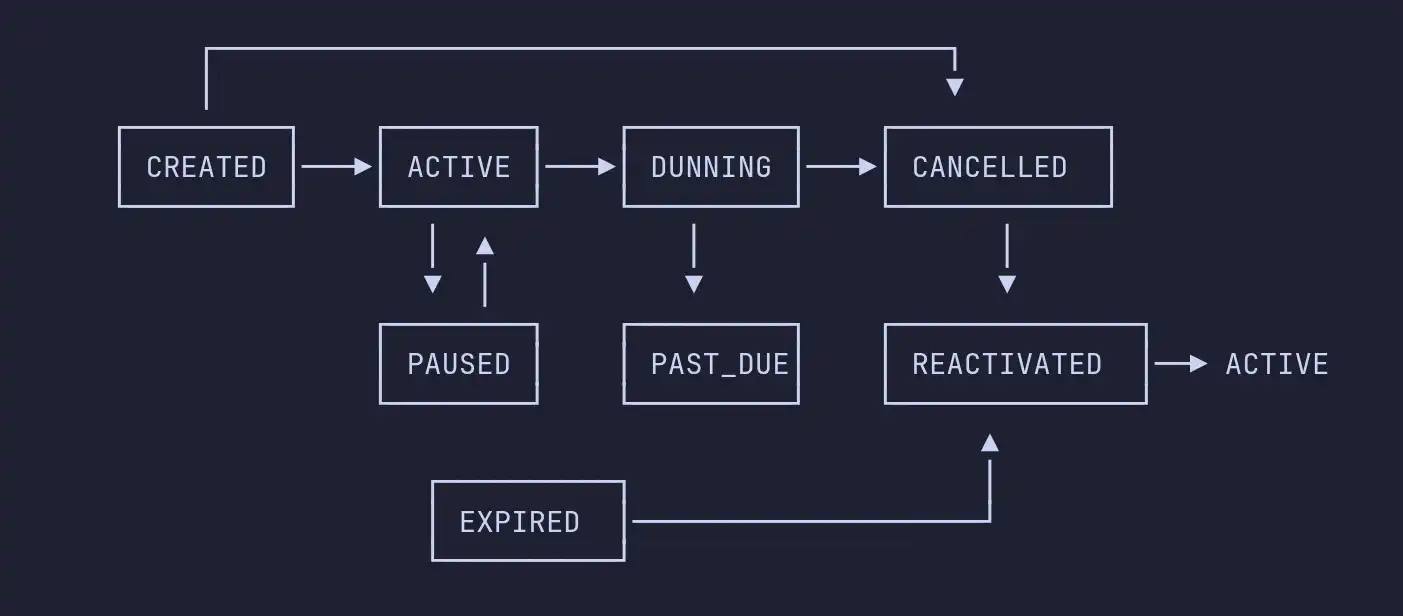
Here’s the thing: every arrow in that diagram isn’t just a connection it’s a business rule, and every rule affects billing somehow. Take the move from ACTIVE to PAUSED. You’ve got to decide if you’re giving people a prorated refund for the days they didn’t use. Now look at DUNNING to CANCELLED. How many times do you retry the payment before giving up, and do you toss out a last-chance “save” offer before you cancel for good?
We handle all this with an explicit state machine in code. This is the pattern we stick to:
from enum import Enum
from datetime import datetime, timezone

class SubscriptionState(Enum):
    CREATED = "created"
    ACTIVE = "active"
    PAUSED = "paused"
    DUNNING = "dunning"
    PAST_DUE = "past_due"
    CANCELLED = "cancelled"
    EXPIRED = "expired"

VALID_TRANSITIONS = {
    SubscriptionState.CREATED:   {SubscriptionState.ACTIVE, SubscriptionState.CANCELLED},
    SubscriptionState.ACTIVE:    {SubscriptionState.PAUSED, SubscriptionState.DUNNING, SubscriptionState.CANCELLED, SubscriptionState.EXPIRED},
    SubscriptionState.PAUSED:    {SubscriptionState.ACTIVE, SubscriptionState.CANCELLED, SubscriptionState.EXPIRED},
    SubscriptionState.DUNNING:   {SubscriptionState.ACTIVE, SubscriptionState.PAST_DUE, SubscriptionState.CANCELLED},
    SubscriptionState.PAST_DUE:  {SubscriptionState.ACTIVE, SubscriptionState.CANCELLED},
    SubscriptionState.CANCELLED: {SubscriptionState.ACTIVE},  # reactivation
    SubscriptionState.EXPIRED:   {SubscriptionState.ACTIVE},  # reactivation
}

class Subscription:
    def transition_to(self, new_state: SubscriptionState, reason: str = ""):
        if new_state not in VALID_TRANSITIONS.get(self.state, set()):
            raise InvalidTransitionError(
                f"Cannot transition from {self.state.value} to {new_state.value}"
            )
        previous_state = self.state
        self.state = new_state
        self.updated_at = datetime.now(timezone.utc)

        # Emit event for downstream systems (billing, fulfillment, analytics)
        self.emit_event(SubscriptionStateChanged(
            subscription_id=self.id,
            previous_state=previous_state,
            new_state=new_state,
            reason=reason,
            timestamp=self.updated_at,
        ))
The VALID_TRANSITIONS dictionary isn’t just a technical detail it’s your guarantee. If you don’t list a transition in there, it won’t happen. It doesn’t matter what wild API call comes in from the frontend or what weird timing issues pop up with concurrent requests. This simple pattern wipes out a whole category of bugs that used to cost us weeks.
Heads Up: One mistake people make all the time is treating
CANCELLEDas a true end state. But reactivation is real and profitable. Recharge says 12% of cancelled subscriptions come back within 60 days if you make it easy enough. If your data model treats a cancellation as a hard delete, you’re shutting the door on reactivation and erasing the subscriber’s history. That’s not just bad for analytics it’s throwing away revenue.
Payment Orchestration
Let’s talk payments. If your subscription ecommerce platform connects straight to one payment service provider (PSP), you’ve got a giant, fragile bottleneck in your revenue stack. We’ve seen this blow up twice: Stripe had a 47-minute outage that killed recurring billing. Another time, a client’s Braintree account got flagged and locked for 72 hours. That’s days of lost income.
Build your own internal payment gateway and hide your PSPs behind it. This isn’t overcomplicating it’s smart risk management. Your abstraction layer should:
- Route transactions smartly: Send US transactions to Stripe, EU ones to Adyen (better rates), and anything risky to a PSP that specializes in those.
- Fail over automatically: If your main PSP throws a gateway error (not just a decline), reroute the payment to your backup PSP.
- Normalize responses: Every PSP spits out decline codes their own way. Map them to your own system so your dunning logic doesn’t become a PSP-specific maze.
- Tokenize payment methods: Never keep raw card data. Use PSP tokens and reference those. Keeps your PCI scope tiny.
This layer is where serious cost optimization kicks in. With 50,000 subscribers, even switching from 2.9% + $0.30 fees to 2.4% + $0.20 saves you over $300,000 a year on $50 average subscriptions. That alone should make you care about abstraction.
Order Management for Recurring Commerce
Subscription orders aren’t just regular orders with a recurring flag slapped on. Three key differences stand out:
-
Fulfillment timing: One-time orders ship as soon as payment clears. Subscriptions follow their own schedule, which might totally ignore payment timing. When we built a specialty food subscription box, billing happened on the 1st, but shipments started on the 15th because they needed fresh ingredients. You have to break billing events apart from fulfillment events.
-
Inventory reservation: When do you set aside inventory? On subscription signup, when the billing cycle starts, or when you’re about to ship? Each approach has pros and cons. Early reservation locks down supply but ties up cash. Waiting is cheaper but risks running out. We’ve found a soft reservation model works: Allocate inventory when billing hits, lock it in at fulfillment, and release if the subscriber skips or cancels.
-
Proration: If someone jumps from a $29/month plan to a $49/month plan halfway through, the math is: $49 - ($29 × 15/30) = $34.50. Looks simple, but layer in discounts, taxes, or multi-item subs and things get messy fast. Stripe Billing can handle basic proration, but anything tricky means rolling your own logic and testing it hard.
Build vs. Buy vs. Compose: What Really Matters
When you’re weighing how to develop your subscription ecommerce platform, you’ve got three choices. Here’s when each one actually makes sense, pulled from real projects we’ve worked on. (For a deeper dive on this decision beyond subscriptions, see our Custom Ecommerce Development: Build vs Buy Decision Guide.)
Full Custom Build
Go custom if: Your billing model is truly unique think usage + subscription hybrid, complex B2B tiers, or subscriber-to-subscriber marketplace payments. If your subscription logic is the heart of your business, not just another feature, building custom is how you win.
Don’t bother if: You’re doing standard replenishment or curated boxes. Building a billing engine from scratch for something Recharge or Stripe already does is the fastest way to burn your budget.
Monolithic Subscription Platforms
Recharge, Bold Subscriptions, Ordergroove these tools layer full subscription management right on top of platforms like Shopify. Out of the box, they’ll handle billing, dunning, subscriber portals, and analytics. Easy to get started, saves you from reinventing every wheel.
When this makes sense: If you’re running your business on Shopify and have a pretty standard subscription setup like a replenishment model, curated boxes, or a straightforward membership and you care more about getting live quickly than customizing every edge case, Recharge is a solid pick. It’s running the show for over 20,000 merchants and usually handles the basics well.
When it doesn’t: If you need a billing system that bends to your every whim, aren’t on Shopify, or think you might move off Shopify later, Recharge probably feels too restrictive. It ties you tightly into their ecosystem, so you’re stuck with what they offer until you rebuild somewhere else.
Composable / Headless Approach
When this makes sense: Say you want full control over how your customers buy, pay, and interact, or you're mixing sales across multiple channels - think web, mobile app, maybe even kiosks. (Not sure what headless actually means? Start with our non-technical guide to headless commerce, or see our detailed headless vs traditional ecommerce comparison.) If you're working with a gnarly tech stack or want subscription billing to fit perfectly with other systems, headless is where you go. You can mix and match tools build the storefront with whatever works, slot in a billing engine, and wire it together to fit your needs.
Typical composable stacks we've seen work well:
- commercetools plus Stripe Billing, with custom middleware in the middle
- Medusa.js with your own billing engine and Adyen for payments
- Shopify’s Hydrogen frontend, Recharge API powering subscriptions, and a custom subscriber portal
When it doesn’t: If you’re still trying to prove your subscription idea or haven’t hit product-market fit, going headless is overkill. It takes time and budget you should probably spend elsewhere.
Comparison Matrix
| Dimension | Full Custom | Monolithic (Recharge, Bold) | Composable / Headless |
|---|---|---|---|
| Time to market | 6–12 months | 2–6 weeks | 3–6 months |
| Flexibility | Unlimited | Only what the platform offers | High-pick best-of-breed pieces |
| 3-year TCO (at 10K subs) | $400K–$800K | $60K–$150K | $200K–$400K |
| Scalability | All on you | Depends on the platform | High, if you plan it right |
| Vendor lock-in | None | High (Shopify lock) | Low to moderate |
| Billing model complexity | Anything goes | Just the basics | High, with your own billing layer |
Pro Tip: If you’re somewhere in that 1,000 to 50,000 subscriber range and need something more flexible than out-of-the-box tools, but don’t need a totally custom build, composable usually hits the sweet spot. The real trick is picking what you want to buy versus what you want to build. Our rule: buy payments, build subscription logic, use a headless CMS for your storefront.
Curious what a custom build actually costs? Our guide on How Much Does It Cost to Build a Custom Ecommerce Platform in 2026? breaks down real numbers by feature, architecture, and team structure.
Not sure whether to build, buy, or compose your subscription platform?
We’ve helped subscription businesses across ecommerce and SaaS figure out the right architecture for their billing complexity, subscriber count, and growth plans - without overbuilding or underspending.
Book a free scoping call and we’ll map your subscription model to the right approach, with a realistic budget and timeline.
The 7 Features That Separate Great Subscription Platforms from Mediocre Ones
After working on a few subscription systems across ecommerce, SaaS, and media, I’ve started noticing a pattern: there seem to be about seven features that really impact subscriber churn. Here’s what We think matters.
1. Intelligent Dunning and Retry Logic
Simply retrying a card three times and then canceling the account isn’t a strategy it’s an invitation for churn. Too many businesses lose 20–40% of their churn to payment failures alone (Recurly’s 2024 benchmark numbers).
A real dunning system does more:
- Repeats charges at different intervals based on why the card was declined. Maybe the bank said “do not honor” try again after two days. Not enough funds? Wait until payday.
- Uses services like Visa Account Updater and Mastercard ABU to swap in fresh card details automatically before you even ask the customer.
- Sends a series of increasingly urgent messages: first a gentle “your payment failed,” then a nudge to update, then last call before canceling.
- Schedules retries based on local time zones, not just in one big batch at midnight UTC. Turns out, billing someone at 10 AM in their own time zone boosts success rates by up to 12% (that’s from Braintree’s own docs).
2. Subscriber Self-Service Portal with Real-Time Proration Previews
Giving customers control over their own subscriptions makes a huge difference. According to Recharge, folks who can self-manage only churn at half the rate of those stuck waiting for support.
But just letting them cancel or change a card isn’t enough. The feature that really matters? Letting them see exactly what they’ll be charged if they upgrade, downgrade, or change plans right now, not after the fact. The portal needs to show a real-time breakdown of what’s due today, including unused days, taxes, discounts all before they hit confirm. Surprises on bills are the single biggest trigger for angry churn complaints. Let them see the numbers up front, and people stick around. (For more on reducing friction at checkout, see our guide on ecommerce cart optimization and how to increase revenue.)
3. Analytics Beyond MRR
MRR sounds impressive, but let’s be honest it’s not all that useful by itself. If you want to really understand your subscription business, you need to track way more than just recurring revenue.
- Cohort retention curves matter. Ask yourself: how many people who subscribed in January stuck around for three months? Six? Twelve? That’s what tells you if folks actually like your product.
- Expansion revenue is key. This isn’t just upgrades it’s add-ons and one-time purchases from your current subscribers. If your expansion revenue’s going backwards because more people downgrade than upgrade, you don’t have a marketing problem. You’ve got a product issue.
- Involuntary churn segmentation digs into why payments fail. Break it down by decline reasons, payment processor, card type, geography. Most of the time, 80% of lost customers come from one stupid decline code. A smarter retry system often solves that.
- Subscriber LTV by acquisition channel tells you where your best customers come from. Someone who finds you organically and sticks around for 14 months is way more valuable than the person who clicked a paid ad but leaves after three even if the paid customer’s first purchase was bigger.
4. Multi-Currency and Tax-Compliant Recurring Billing
Now, if you’re selling subscriptions around the globe which, let’s face it, everyone is at this point-your billing needs to handle multiple currencies and tax rules. Not just when someone signs up, but every time you charge them. Exchange rates change daily, so you want conversions at charge time, not signup. And recurring taxes? That’s a headache. The rules bounce all over the place depending on where your subscriber lives. Especially in the US, where state laws keep changing thanks to court decisions like South Dakota v. Wayfair. Plug into Avalara or TaxJar and let them sort out the tax calculations. Building your own tax logic is asking for trouble.
5. Subscription Gifting and Prepaid Flows
Gift subscriptions can give you a nice revenue boost Cratejoy saw 18% of their Q4 2024 subscription boxes bought as gifts but they complicate things. You’re not just dealing with one account. You get a purchaser and a recipient. After the prepaid period, nobody owns the payment method. The gift might start in the future, on the delivery date. And when the prepaid ends, the recipient has to decide if they want to pay to continue. Each part of this flow takes real engineering work; it’s trickier than it looks.
6. API-First Webhooks for Subscription Lifecycle Events
Every time a subscription’s state changes, send a webhook. Seriously, not just when someone creates or cancels send one when they pause, when dunning starts, when a payment fails, when renewal’s coming up (give them a heads-up three to seven days before), and when they reactivate. These webhooks are how the rest of your business stays up-to-date. Your email provider, analytics team, fulfillment, customer support all need this info right away. The best systems are API-first, with signed payloads, automatic retries if something fails, and a log so you can replay events if you need to. Don’t cut corners here.
7. Graceful Upgrade/Downgrade with Mid-Cycle Proration
Handling upgrades and downgrades? It’s unbelievably common for platforms to treat these as cancel-and-resubscribe. That wipes the subscriber’s history, breaks their loyalty status, and messes up billing. Instead, treat plan changes as in-place modifications. Adjust the bill, keep their ID and history, and their benefits roll over smoothly.
Common Technical Pitfalls and How to Avoid Them
Let’s talk about technical screw-ups we’ve seen out in the wild. Some are from stuff we built, others from messes we got called in to fix.
Race Conditions in Concurrent Subscription Modifications
Take race conditions with subscription changes. Imagine someone hits pause on their phone, while the backend’s prepping their next renewal. Without good controls, you end up charging a paused subscription and a pretty angry customer.
The fix? Go with optimistic locking and version counters. Each change checks if the record’s been updated since last read. If something changed, the write fails. The billing worker tries again, sees the subscription’s paused, and skips the charge.
Timezone Bugs in Billing Cycle Calculations
“Bill on the 1st” means something different in PST, EST, and UTC. If you store renewal dates in UTC, but set the billing anchor in a local timezone, you’re going to charge some people a day early and others a day late. That’s a recipe for confused customers.
Fix: Always store each subscriber’s timezone alongside their billing anchor date. When you need to figure out the next renewal, work in their local time - lock the renewal to midnight in the user’s timezone, then convert it to UTC for actual scheduling. Use a proper timezone-aware datetime library. Don’t rely on raw offsets; those break as soon as daylight saving time kicks in.
Failing to Separate Subscription Intent from Payment Execution
This one really messes up your architecture. If you treat “create subscription” and “charge first payment” like a single step, a payment failure means the subscription record never gets created. Now the customer has to start the whole checkout all over again and your analytics are in the dark. You can’t even see who tried and failed to subscribe because there’s no trace.
Fix: When someone starts the process, create the subscription right away, but set it to a CREATED state. Then handle the payment separately. If payment goes through, switch the subscription to ACTIVE If payment fails, you keep the subscription in CREATED now you can retry the card, ask the customer to update their info, or let them pick a new payment method, all without losing the work they did or their preferences.
Ignoring PCI Compliance Scope Creep
Here’s how this usually goes. At first, you use Stripe Elements or something similar fully PCI-compliant, low risk, all good. Then a PM asks for a “saved cards” section where customers can see their last four digits and card expiration dates. Then someone wants support to be able to take card numbers over the phone and punch them in. Now your codebase is touching card data, and overnight your PCI compliance blows up from SAQ A (about 20 compliance questions) to SAQ D (think 300+).
Fix: Whatever you do, don’t let card data hit your application. Stick to PSP-hosted card forms (Stripe Elements, Adyen Drop-in, Braintree Hosted Fields) everywhere even for admin or internal tools. If you need to show card details, pull them via your PSP’s API and never store anything sensitive yourself.
Over-Engineering Pricing Before Validating Product-Market Fit
This happens all the time. The team spends months building a monster billing system: usage pricing, volume discounts, multi-currency support, annual payments, the works. Meanwhile, you’ve got 47 beta users, and you’re not even sure people want your product yet.
Fix: Start with one plan, one cycle, one currency. That’s it. Prove people care. Later, when real customers start asking for fancier options, you can build up. In the beginning, Stripe Billing or a simple homegrown setup gets the job done without a huge engineering lift.
Watch out: The opposite mistake is making everything too rigid. Don’t paint yourself into a corner. You don’t need to over-engineer, but use clean abstractions like a simple state machine for subscriptions and an interface to your PSP so you can add complexity if and when the business grows.
Dealing with subscription billing bugs or scaling issues?
We’ve been called in to fix broken billing systems, race conditions, timezone bugs, and compliance gaps for subscription businesses at every stage. We know exactly where things go wrong.
Book a free scoping call and we’ll audit your current architecture, identify the highest-risk areas, and give you a clear fix-or-rebuild recommendation.
Tech Stack Recommendations
Here’s what I’d pick for a modern subscription e-commerce platform, depending on size. There are plenty of valid options, but these are the ones that balance speed, reliability, and flexibility.
Early Stage (Under 1,000 Subscribers)
Goal: Move fast, spend little, keep it simple.
- Ecommerce + Subscriptions: Shopify + Recharge (if you’re OK with their constraints), or Medusa.js + Stripe Billing if you want to tweak things
- Backend: Node.js (with TypeScript) or Python (FastAPI). Go with whatever your team ships faster in.
- Database: PostgreSQL. Nothing else needed for now.
- Queue: Don’t bother yet Stripe Billing covers most scheduling and retries
- Monitoring: Stripe Dashboard plus Sentry for errors
- Hosting: Vercel (for frontend), Railway or Render (for backend)
Ballpark cost: $50–$200/month plus payment processor fees.
Growth Stage (1,000–50,000 Subscribers)
Goal: Build a subscription engine you control. Measure everything.
- Backend: Node.js (TypeScript) with NestJS, or Python with FastAPI-typed languages pay off for billing code.
- Database: PostgreSQL. Use row-level locking to handle simultaneous subscription updates. Add Redis for caching state and limiting rates.
- Queue: Amazon SQS, or BullMQ (Redis-backed). Each renewal gets its own job, with retries and dead-letter handling.
- Payments: Build an abstraction layer over Stripe, and add a backup PSP (Adyen or Braintree).
- Search/Analytics: Ship events to a data warehouse (BigQuery or Snowflake). Build cohort dashboards with Metabase or Looker.
- Tax: Plugin an API like Avalara or TaxJar.
- Hosting: AWS (ECS, EKS) or GCP (Cloud Run).
Ballpark cost: $2,000–$8,000/month, plus payment fees.
Scale Stage (50,000+ Subscribers)
When you reach over 50,000 subscribers, your focus shifts - speed, reliability, and keeping costs down aren’t just nice to have, they’re absolutely critical.
For billing, event sourcing is the go-to architecture. Every change to a subscription is logged as an event that never gets overwritten. Need to know exactly what happened with a subscriber’s account three years ago? Just replay all the events and reconstruct the whole story. This approach gives you a built-in audit trail and sets the stage for CQRS, meaning your system can have a separate data structure for reading versus writing subscription info.
Real-time event streaming is a must, too. Tools like Apache Kafka or Amazon Kinesis handle the barrage of live subscription events and keep everything moving smoothly.
PostgreSQL remains your core database for subscriptions, but when it’s time to crunch big numbers or track analytics over time, ClickHouse or TimescaleDB step in. They’re made for handling massive amounts of data efficiently.
Payments get smarter at this scale. You’ll want an orchestration layer that makes decisions based on things like card type or user location, always looking for the best path to success and lowest costs. Platforms like Spreedly or Primer are built for exactly this kind of complexity.
On the infrastructure side, you’ll be running Kubernetes and keeping a dedicated node pool just for billing workers. Billing tasks shouldn’t fight with your web servers for resources.
Small improvements become huge: even a 0.1% boost in payment success means serious money. Dig deep into payment analytics and don’t be afraid to A/B test different retry strategies.
What's Coming Next: 2025–2026 Trends
Looking ahead, four big trends are changing how subscription ecommerce platforms are built-better to start planning for them now, even if you wait to implement:
AI and machine learning are coming for churn prediction. (For a broader look at how AI is reshaping ecommerce, see our guide on AI in Ecommerce: 15 Use Cases Transforming Online Retail.) Instead of waiting for a subscriber to cancel and then scrambling with a “save” offer, new platforms are using behavioral signals (how often people log in, their support ticket tone, interaction patterns) to spot potential churn as much as 30–60 days ahead. Retention.com and Chargebee already offer early versions. If your event architecture captures these signals now, you’ll be ready to plug in those models later.
Hybrid models are everywhere. Subscriptions aren’t just flat fees anymore - now, customers pay a base, then fork out more for usage. Stripe’s 2024 analysis says almost 40% of new subscription businesses are adding usage-based billing. Make sure your engine can handle both metered and recurring charges. (If you’re building a SaaS product with usage-based billing, our Custom SaaS Development Guide digs deep into these architecture decisions.)
Subscriptions are slipping into unexpected places. Fitness apps selling supplement subscriptions, project management tools offering template libraries, gaming platforms with in-game item subs. If you build a billing system, think about whether it can be embedded in other platforms. That’s a business model waiting to happen.
Real-time analytics change the game. Instead of waiting till tomorrow to spot a spike in failed payments on your dashboard, streaming architectures let you see it happen, right now. With tools like Kafka+Flink or Kafka+ClickHouse, you can react quickly maybe even stop churn before it starts.
Conclusion: Three Things That Matter Most
After spending time working across subscription commerce, We’ve started to notice three things that truly matter.
First, treat your subscription as a state machine. Seriously, this step catches bugs, helps clear up weird edge cases, and cuts down on engineering headaches. If you only remember one thing, define VALID_TRANSITIONS and enforce it at the domain level.
Second, split intent from payment. Make the subscription record before you try to charge. This boosts conversion rates since failed payments don’t ruin the signup process, gives you clearer analytics thanks to measuring intent versus completion, and opens the door for recovery flows like retries or alternative payment methods.
Third, handle billing logic yourself, but leave payment processing to the pros. Let Stripe, Adyen, or Braintree take care of card charging and token management. Keep control over when and how you charge, how you handle proration, what happens after a failed payment, and all plan changes. That way, you can evolve your system without waiting for some provider’s next feature or roadmap.
Take a hard look at your current subscription stack and compare it against these three points. When logic ends up scattered and undocumented, that’s usually where problems start outages, billing mistakes, and unhappy customers.
If you’re building a subscription ecommerce platform and want to run your architecture by folks who’ve been there, we’d be happy to chat.
Ready to build a subscription platform that actually scales?
We build subscription commerce infrastructure, billing systems, and recurring revenue platforms for ecommerce and SaaS companies. We tackle the tough parts: billing engine design, payment orchestration, and subscription lifecycle management.
Book a free scoping call and we’ll review your subscription model, identify the technical risks, and give you a clear architecture plan with realistic costs.


